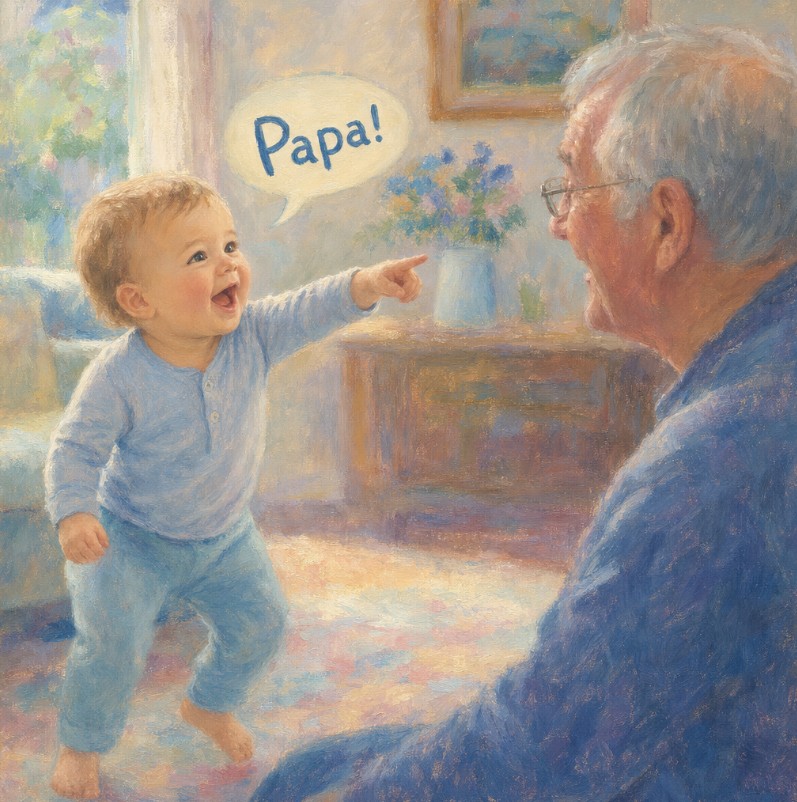
Is there anything more exciting than hearing your baby say their first word? Whether it is “Mama,” “Dada,” “ball,” or even “woof,” those first little words are unforgettable.
But when do babies say their first word? And what actually counts as a word?
Some babies begin using recognizable words before their first birthday, while others take a little longer. Rather than focusing on one exact baby’s first word age, it can be helpful to look at the whole picture:
- Is your baby babbling?
- Using gestures?
- Looking at you to share interest?
- Trying to get your attention?
- Understanding familiar words?
These are all important building blocks for talking.
Talking is not a race, and there is no single exact first words age that applies to every baby. Babies are busy developing many skills at once, and each child follows their own developmental path.
What Do Baby’s First Words Sound Like?
Your baby’s first words may sound surprisingly similar to babbling.
Hopefully, your baby has been cooing—making vowel sounds—and then progressing to babbling, where consonants and vowels are combined. You may hear strings of sounds such as:
- Nanana
- Babababa
- Gagagaga
- Dadadada
- Mamama
Unsurprisingly, many baby first words follow a similar pattern:
- Mama
- Dada
- Nana
- Papa
- Baby
- Puppy
These words often contain sounds and syllable patterns that babies have already been practising through babbling.
What Actually Counts as a First Word?
A first word does not have to sound perfect.
“Ball” might sound like “ba.” “Bottle” might be “baba.” “Dog” might be “dah.” If your baby says “woof” whenever they see a dog, that can count too!
What matters is that your baby uses the same sound consistently and intentionally to mean the same thing.
For example, if your baby babbles “mamamama” while happily playing with a toy, that may simply be babbling. But if your baby looks at Mom, reaches toward her and says “Mama,” that is a meaningful word.
The key is consistent meaning and intention.
Your baby does not need perfect pronunciation. They simply need to use a sound in a way that is consistently recognizable to you.
You Cannot Make Your Baby Talk—but You Can Set the Stage
It can be frustrating when you are eagerly waiting for those first words because you cannot simply “make” your baby say them. You can guide your baby to wave or clap their hands, but you cannot make their lips, tongue, teeth and palate form a word on command.
It may seem as though all you can do is wait.
But there are actually many things you can do—and chances are, you are already doing many of them.
Reading, singing, fingerplays, rhymes, talking and simply playing with your baby all help build the foundations for language.
But there is something else that is equally important:
Leave space for your baby to communicate.
Talk—and Then Give Your Baby a Chance to Respond
Parents often hear that they should talk to their babies, and that is certainly good advice. But sometimes we adults are so busy talking, asking questions, naming things and filling every silence that babies do not get much opportunity to take a turn!
Try asking:
“Do you want milk or water?”
Then wait.
Your baby may look at the milk. They may point, reach, make a sound or attempt a word. Whatever they do, respond as though their communication matters—because it does.
Baby says: “Mmmm.”
Adult responds: “Oh, you want mmmmmilk!”
Baby points to the milk.
Adult responds: “Oh, I see! You want mmmmmilk!”
You are showing your baby that their attempts to communicate have meaning while also giving them a clear model of the word they may eventually say.
Animal Sounds and Fun Noises Can Be First Words Too
One way to encourage your baby’s first words is to use animal sounds, environmental noises and fun exclamations. These can often be easier for babies to imitate than conventional words.
Try sounds such as:
- Animal sounds: meow, woof, moo, baa, peep-peep
- Vehicle sounds: vroom, beep-beep
- Fun exclamations: whee, yay, uh-oh
- Everyday sounds: shhh, mmmm, brrr
You can simply demonstrate these sounds as you go about your day. But for even greater effect, try using them during a few minutes of pretend play.
“Shhhhhh. Teddy is sleeping.”
“Brrrr! Teddy is cold! Let’s get Teddy a blanket.”
“Zzzzzzz! Oh no! Here comes a bee. The bee is going to wake Teddy!”
“Zzzzzzz! Shhhhhh, bee! Teddy is sleeping!”
Then wait.
At first, your baby may simply manipulate Teddy and the blanket. But after a few repetitions of the routine, perhaps your baby will put a finger to their lips. Eventually, you might even hear a little “shhhhhh.”
This is how communication grows—through fun, repetition, interaction and many opportunities to take a turn.
Use Gestures and Signs to Encourage Communication
I also often recommend using simple signs and gestures with babies.
Signs are meaningful symbols, just like spoken words. You do not have to teach yourself dozens of ASL signs. You can start with just a few useful ones, such as:
- More
- Eat
- Milk or drink
- All done
- Help
Use signs and gestures naturally throughout the day and during play routines. Always say the word while making the sign.
Pairing a sign with a spoken word gives your baby another way to communicate while spoken language is still developing. Signs do not prevent babies from learning to talk. Instead, they can reduce frustration and help babies experience the power of successful communication.
As babies become able to say the words, they often naturally use the signs less.
One Thing You Can Do With Your Little One Today
Try adding one or two simple signs to your baby’s daily routine.
The sign for milk is made by opening and closing one hand into a fist, almost as though you were milking a cow.
The sign for more is made by bringing the fingertips and thumb of each hand together and then tapping the fingertips of both hands together.
Remember, your baby does not have to make a sign or say a word perfectly. Their attempt simply needs to be consistently recognizable to you.
If your baby’s version of the sign for “more” is a clap, a tap or a movement that looks slightly different from the adult version—but you know exactly what they mean—that is communication!
A Thought from Cheryl
While we cannot make children talk, there is much we can do to set the stage for talking.
Reading, singing, rhyming, fingerplays, looking at pictures and talking about what your baby is seeing, hearing, feeling, tasting and smelling can all provide wonderful opportunities for language development.
But don’t forget to leave space for your baby.
Sometimes the most helpful thing you can do is say something—and then quietly wait. Give your baby time to look, gesture, reach, make a sound or attempt a word. Communication is a two-way exchange, and even before babies can talk, they have plenty to say.
The Bottom Line
If you are wondering when infants start talking, remember that spoken words are only one part of a much bigger communication picture.
Look for the many ways your baby is already trying to connect with you. Are they babbling? Using gestures to get your attention? Smiling and looking at you? Pointing to things that interest them? Blowing kisses or waving bye-bye? Understanding familiar words and simple directions?
These are all important communication skills.
If you have any reason to be concerned about your baby’s speech or language development, it is wise to seek advice from a speech-language pathologist. An assessment can be reassuring if your child is developing as expected. And if your child does need some extra help, you can walk away with answers and a plan for supporting their communication development.
In the meantime, keep talking, playing, reading, singing—and waiting. Those first little words are built on hundreds of everyday moments of connection.