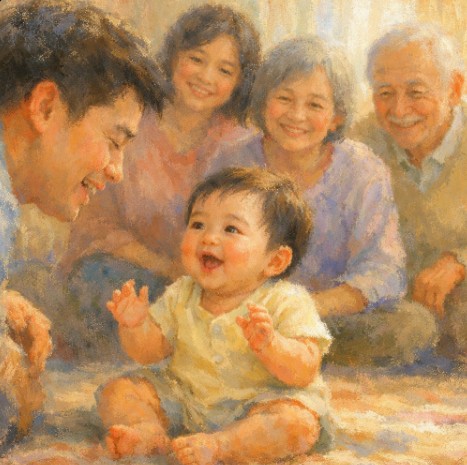
After a few weeks of cooing with those soft vowel sounds, parents start listening eagerly for the next exciting milestone—babbling.
Most babies begin babbling between 4 and 6 months of age, although there’s a wide range of normal. These first sounds are usually simple combinations of one consonant and one vowel, such as “ba,” “ga,” or “ma.”
Sometime between 6 and 9 months, babies often begin repeating those syllables: “dadada,” “bababa,” “nanana,” and “gagaga.”
For speech-language pathologists, this is an exciting stage because we know what all this practice will eventually lead to…
Words!
But not just yet.
What Is Babbling?
Babbling is the stage of speech development when babies begin combining consonants and vowels into simple sound combinations like “ba,” “ma,” and “ga.”
Unlike cooing, which is made up mostly of soft vowel sounds, babbling uses the lips, tongue, jaw, voice, and breathing together. It’s your baby’s first real practice for talking.
What Does Babbling Sound Like?
Babbling changes as babies grow.
Around 4 to 6 months, many babies begin making simple sounds such as:
- ba
- ma
- ga
- da
By 6 to 9 months, these often become repeated:
- bababa
- dadada
- nanana
Later, many babies begin mixing sounds together:
- guh-ba-duh
- kee-bee-nee
- ma-da-ga
This stage is often called “jargon” because it sounds surprisingly conversational, even though your baby isn’t using real words yet.
Babies often use pitch, rhythm, and intonation that make it sound as though they’re speaking another language. Parents frequently find themselves answering these pretend conversations—and that’s actually a wonderful thing!
Gone are the soft “oohs,” “aahs,” and “goos” of cooing.
Your baby is now intentionally experimenting with speech sounds and getting ready to talk.
Why Do Babies Babble?
Babbling isn’t just cute—it serves an important purpose.
Your baby is:
- Practicing the movements needed for speech. They coordinate their lips, tongue, jaw, voice, and breathing. These early vocal experiments help them learn the movements they’ll later use to produce words.
- Learning how their own voice works. As babies listen to themselves, they discover they can make different sounds on purpose.
- Hearing language at exactly the moment they’re paying the most attention. When you repeat your baby’s babble and then add a few simple words, you’re giving them language when they’re most ready to learn.
- Discovering that communication works. Your baby learns that making a sound brings a warm, loving response.
- Learning the rhythm of conversation. Babble… pause… respond… repeat. Those tiny back-and-forth exchanges are the beginning of turn-taking—the foundation of every conversation your child will ever have.
Developmental researchers call this serve and return.
Your baby serves a sound: “Ba!”
You return it.
Those tiny back-and-forth exchanges build the brain connections that language is built on.
How to “Babble Back” and Grow Your Baby’s Language
You don’t need special toys or expensive lessons—just your face, your voice, and a few unhurried minutes.
Some of the best opportunities happen naturally during your day. If your baby wakes up happy and quietly babbling, spend a few minutes “chatting” before lifting them from the crib. Diaper changes, getting dressed, and bath time are all wonderful times to enjoy little babbling conversations.
Whenever your baby is calm and alert, remember this simple pattern:
Get Face to Face… Babble Back… Pause… Wait… Respond.
- Get face to face. Babies love seeing your face—especially your eyes and mouth.
- Copy your baby’s sound. If your baby says “guh,” say “guh” right back using a warm, sing-song voice. Babies love being imitated. You might even add a few extra “guhs.”
- Pause and wait. This may be the most important step. Give your baby several seconds to take another turn. If we fill every silence, our babies never get a chance to “talk.”
- Respond with delight. Smile. Light up. Answer their babble. You’re teaching your baby that their voice matters.
A few short, joyful conversations each day can make a real difference.
Don’t worry if your baby doesn’t babble back right away. Asking your baby to babble on cue is asking a lot—they’re still learning to make these sounds on purpose.
Often the best approach is simply to wait until your baby babbles first, then join the conversation by babbling back.
What If My Baby Isn’t Babbling Yet?
As I always say, I have never met a baby who has read the milestone chart!
Babies develop on their own timelines, and there’s a wide range of normal.
A baby who is a week or two behind a milestone chart is often doing just fine, especially if they’re alert, making eye contact, smiling, and responding to your voice.
One of the first things I’d think about is whether your baby is hearing speech clearly.
Most babies born in North America have their hearing screened before leaving the hospital. However, babies can sometimes develop temporary fluid behind the eardrum after birth or during an ear infection. If sounds are muffled, babies may be less interested in experimenting with their own voices.
That said, you know your baby best, and it’s always okay to mention your concerns to your healthcare provider.
I’d suggest bringing it up if:
- your baby isn’t babbling by about 9 months
- your baby doesn’t seem to react to sounds or your voice
- your baby rarely makes eye contact or facial expressions
- your baby started babbling but then stopped
None of these automatically mean something is wrong. They simply deserve a conversation with your healthcare provider.
One Thing You Can Do Today
The next time your baby babbles…
Repeat the sound back.
Then wait.
Some babies are naturally quiet observers, but that doesn’t mean they aren’t learning. Keep talking, singing, reading rhymes, and enjoying everyday moments together.
If your baby isn’t yet ready for back-and-forth babbling, you can still enjoy turn-taking through games like Peek-a-Boo, Pat-a-Cake, gentle tickles, or simply smiling back and forth.
These playful interactions are building the same communication skills.
A Thought from Cheryl
You don’t have to answer your baby’s babbling with more babbling every time.
You can also respond with real language.
Baby: “Gaga.”
Parent: “Gaga! You sure have a lot to say today! Are you telling me all about your morning?”
When you respond to your baby’s vocalizations, your baby begins to understand:
“I have a voice, and the people I love listen and answer me.”
Every babble you respond to is another brick in the foundation of a lifetime of communication.
The Bottom Line
One of the wonderful things about babbling and jargon is that adults naturally begin giving these sounds meaning—and that’s part of how words develop.
We’ve all seen the videos of an 8-month-old saying “dada” while everyone celebrates.
“Did you hear him? He said ‘dada!’ Say it again!”
The baby probably wasn’t intentionally referring to Dad yet. They were simply practicing sounds.
But after enough joyful reactions, babies gradually begin connecting that sound with this special person—and eventually “dada” becomes a real word with meaning.
So go ahead and respond as though your baby’s sounds have meaning.
“Are you talking about Mama? Are we going to see Nana today?”
Those playful conversations help babies learn that sounds can represent people, objects, and experiences.
Before long, those happy little babbles begin turning into real words.