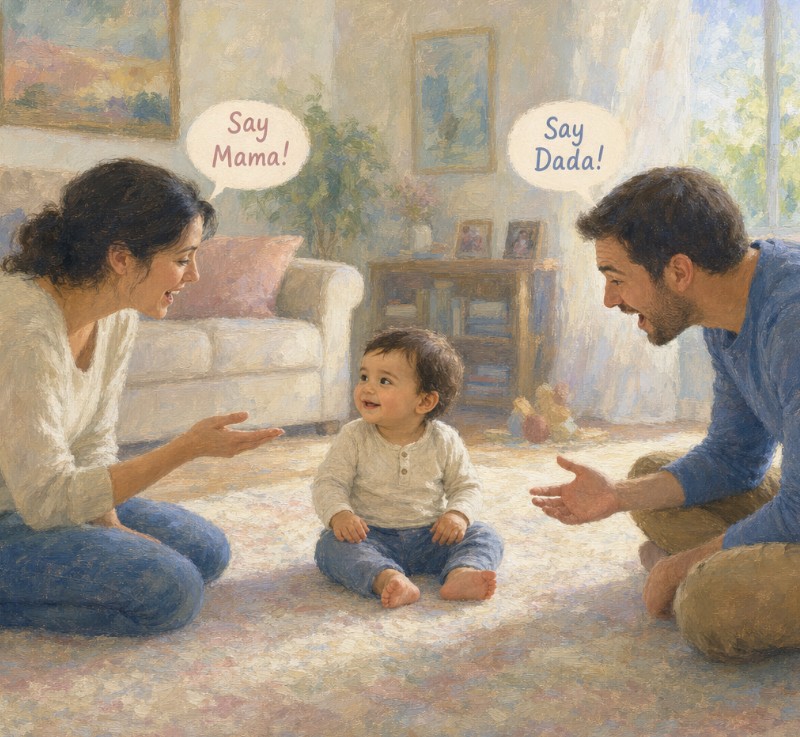
Excited—and sometimes anxious—new parents often ask, “When do babies say mama?” or “When do babies say dada?”
I wish I could give you an exact date, but the truth is that babies develop at different rates. Many babies begin using meaningful words like mama and dada around their first birthday. Some start a few months earlier, while others take a little longer.
Rather than focusing on one exact age, it helps to look at the whole picture. Is your baby babbling? Using gestures? Looking at you to share interest? Trying to get your attention? Understanding familiar words? Trying to imitate sounds?
All of these are important parts of learning to communicate.
How Does Babbling Turn Into “Mama” or “Dada”?
Mama and dada are often among the first group of words babies learn to say. That’s partly because these words closely resemble the babbling your baby has already been practising for months.
Babbling usually comes after cooing, when babies mostly play with vowel sounds. As babbling develops, babies begin putting consonants and vowels together:
- Bababababa
- Gagagagaga
- Nanananana
- Mamamamama
- Dadadadada
- Papapapapa
You can encourage your baby to babble by responding to those sounds. If your baby says “bababa,” try saying “bababa” back and then waiting to see what happens.
Your baby may make another sound. You respond. Then you wait again.
Suddenly, the two of you are having a little conversation—even though neither of you is using actual words!
You can also simply talk to your baby when they babble:
“Oh, you have a lot to say today, don’t you? Yes, you do!”
These little back-and-forth exchanges teach your baby something very important: When I make a sound, someone responds. My sounds can affect other people.
How Does “Dadadada” Become “Dada”?
Parents often assign meaning to a baby’s babbling—and that’s not a bad thing at all!
Imagine your baby is lying on the floor happily babbling:
“Dadadadadada!”
Suddenly, everyone gets excited.
“Did you hear that? He said Dada! Say it again! Say Dada!”
Of course, your baby may simply be playing with sounds at this point. But all that excitement might get your baby thinking:
“Well, that was cool! They got excited about that. Maybe I’ll do it some more.”
“Why does that man get so excited every time I say dadadada?”
“Ohhhhhhh! Dada means that man!”
And voilà! We have a word!
Your baby has made an enormous discovery: Sounds can carry meaning. A particular sound can represent a person, an object, an action, or an idea. That discovery opens the door to spoken language.
Does It Count as a Word If My Baby Says “Mamamama” or “Dadadada”?
Not necessarily. Babies often babble sounds like mamamama and dadadada before they understand that those sounds refer to particular people.
It begins to count as a word when your baby uses the sound intentionally and consistently to mean the same thing.
For example, if your baby looks at Mama, reaches for her, and says “mama,” that’s much more likely to be a real word.
And don’t worry if the word isn’t perfectly clear. Your baby doesn’t have to say “mama” exactly the way an adult does. Mama, ma-ma, ma, or even another consistent approximation can count as a word if your baby uses it intentionally and consistently with meaning.
The same is true for other first words. Ba might mean ball. Wa-wa might mean water. Baba might mean bottle.
The important thing is that your baby is using a particular sound to communicate a particular meaning.
Why Do Some Babies Say “Dada” Before “Mama”?
If your baby says dada before mama, don’t take it personally! Babies aren’t choosing favourites. They are simply experimenting with the sounds that happen to be easiest or most interesting to them at that moment.
Sometimes parents unintentionally help too. Mama may spend all day saying:
“Look, there’s Dada! Dada’s home! Let’s go find Dada!”
Meanwhile, nobody is following Mama around all day saying:
“Look! There’s Mama! Mama’s making lunch! Let’s go find Mama!”
Your baby may also choose an entirely different first word. Ball, dog, hi, bye, or uh-oh can all be first words.
The important thing isn’t which word comes first. It’s that your baby is beginning to understand that sounds can carry meaning.
What Are Some Common First Words?
Mama and dada are common first words, but babies have their own ideas about which words are important enough to say! Other early words might include:
- Papa
- Nana
- Baby
- Puppy
- Night-night
- Uh-oh
- Baba for bottle
- Wawa for water
Babies learn first words by hearing them often in meaningful, everyday situations and by having adults respond to their attempts to communicate.
You don’t need flashcards or formal lessons. Talk about what your baby is looking at, what they’re doing, and what is happening around them.
- “There’s Dada!”
- “Baby’s bottle.”
- “Doggie! Woof-woof!”
- “Uh-oh! Spoon fell down.”
These simple, everyday interactions give your baby many opportunities to connect sounds and words with meaning.
Can Books Help My Baby Learn “Mama” and “Dada”?
Yes! Books about families, mothers, fathers, babies, and familiar routines give you lots of natural opportunities to repeat words like mama and dada.
You can also look at family photographs together. Point to familiar people and name them:
- “There’s Mama!”
- “Look! Dada!”
- “There’s Grandma!”
You don’t need to quiz your baby by repeatedly asking, “Who’s that? Who’s that?” Simply point, name, smile, and talk about the people your baby knows and loves.
Some books you might enjoy include:
- Are You My Mother? by P. D. Eastman
- Are You My Mommy? by Mary Murphy
- I Love My Mommy by Lianna LaRocca
- I Love My Daddy by Lianna LaRocca
- Little Voices, First Words by Cheryl Turner
One Thing You Can Do Today
Start naming people’s possessions.
- “Dada’s shoes.”
- “Mama’s cup.”
- “Baby’s spoon.”
This adds another element of interest to those important names. You can even be silly:
“Is this Mama’s shirt? Let Mama put it on. Ugh! Oh no! It doesn’t fit! This is not Mama’s shirt. This is Baby’s shirt!”
Babies love silliness, surprises, and repetition. You don’t need to drill your baby on the words mama and dada. Just find natural, playful ways to use the words throughout the day.
A Thought from Cheryl
If your baby isn’t saying mama or dada yet, don’t feel that you have to practise those two words over and over.
Sometimes another kind of sound is easier—and more fun—for a baby to imitate.
If your child understands familiar words, follows simple directions, enjoys back-and-forth interaction, and has been doing lots of babbling but isn’t yet saying words, try introducing some fun animal sounds, environmental sounds, and exclamations:
- “Vroom!” goes the car.
- “Mmmmm!” This cookie is yummy.
- “Baa!” goes the sheep.
- “Meow!” says the kitty.
- “Uh-oh!” Something fell down.
- “Zip!” goes your jacket.
These playful sounds can be wonderful stepping stones toward words. A baby who consistently says “vroom” for a car, “baa” for a sheep, or “meow” for a cat is using sounds with meaning—and that’s an important step in learning to talk.
If you’re looking for books filled with fun sounds to share with your baby, you might enjoy Moo-Moo by Sebastian Braun or Little Ears, Big Sounds by Cheryl Turner.
The Bottom Line
If you are wondering, “When do babies say mama?”, “When do babies say dada?”, or “When do babies start saying mama?”, remember that there isn’t one exact date that applies to every child.
Many babies begin using meaningful words around their first birthday. Some start earlier, while others take a little longer.
Rather than focusing only on whether your baby can say mama or dada by a particular age, look at the whole picture. Is your baby babbling? Using gestures? Looking at you to share interest? Trying to get your attention? Understanding familiar words? Trying to imitate sounds? Making progress in their communication?
And remember: your baby’s first word may not be mama or dada at all. It might be ball, dog, hot, up, cookie, or something else that has captured their interest.
The really exciting milestone is this: Your baby is beginning to understand that sounds can carry meaning.
And once your baby makes that discovery, a whole new world of communication begins to open up.
If you are concerned that your baby isn’t beginning to use words or make progress with communication, don’t wait to ask for help. Talk to your healthcare provider or seek a referral to a speech-language pathologist.
After a comprehensive assessment, you may find that your child simply needs a few additional activities to try at home, or they may benefit from more intensive support. Either way, you will walk away with more knowledge and a plan—and both can bring valuable peace of mind.