Many children say their first meaningful word around their first birthday, often sometime between 10 and 15 months. However, there is a wide range in early language development.
By the time children enter the toddler years, many are already communicating with a few words, sounds, gestures or word approximations. Over the next year, those early words often grow into a larger vocabulary and short phrases.
Some common first words include:
- Mama
- Dada
- Nana
- Papa
- Up
- No
- Mine
- Puppy
- Baby
- Hot
- Kitty
- Ball
- More
- Go
- Bye-bye
Sound effects and animal sounds may also be some of your toddler’s first meaningful communications:
- Woof
- Moo
- Beep-beep
- Uh-oh
- Wow!
Toddlers do not begin by saying words perfectly. Their first words may sound quite different from the words adults use—and parents do not always realize that their child is already talking!
Why Are Mama and Dada Often First Words?
You may notice that several common first words—such as Mama, Dada, Nana and Papa—sound similar to a baby’s earlier babbling.
For months, your baby may have practised babbling strings of sounds such as:
“Bababa.”
“Mamamama.”
“Dadadada.”
“Nananana.”
These sound combinations contain repeated sound patterns that are often easier for young children to produce. A baby who has spent months saying “dadadada” already has plenty of practice making the sounds in Dada.
Sometimes babies may even say Mama or Dada accidentally while they are babbling. Then something interesting happens—the adults become very excited!
Your baby may think:
“Oh! I get extra attention when I say ‘Dada.’ Maybe I will say it again.”
Then:
“Every time I say ‘Dada,’ this man gets very excited. Okay, I get it. ‘Dada’ means that man I love!”
Gradually, a sound that began as babbling becomes a meaningful word.
Does It Count as a Word If My Toddler Does Not Say It Clearly?
Yes! Your toddler does not need to pronounce a word perfectly for it to count as a word.
Learning to talk requires your toddler to coordinate their tongue, lips, jaw, teeth and palate. These movements take time and practice. As a result:
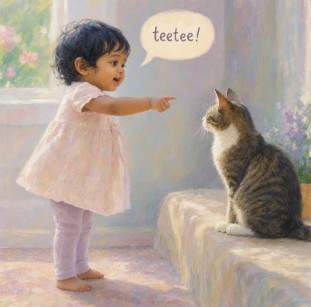
- Kitty may sound like “teetee”
- Bottle may sound like “baba”
- Banana may sound like “nana”
- Cracker may sound like “tatoe”
These simplified words often contain sounds and syllable patterns that are similar to the babbling your toddler has already practised.
A word generally counts when your toddler:
- Uses it independently
- Uses it consistently
- Uses it with meaning
For example, if your toddler says “baba” every time they see or want their bottle, baba is functioning as a word—even though it does not sound exactly like bottle.
If your toddler says “tseep-tseep” whenever they see a bird, that also counts as a word. If they consistently call every vehicle “car,” that counts too—even if they use the word for trucks, buses and tractors.
Early words do not need to sound perfect. What matters is that your toddler is using a sound or word consistently to communicate a particular meaning.
How Should I Respond When My Toddler Says a Word Incorrectly?
Respond warmly to every meaningful communication attempt.
You do not need to tell your toddler that they said the word incorrectly or ask them to repeat it until it sounds right. Simply respond to what they meant and naturally model the word correctly.
For example, if your toddler says:
Toddler: “Tatoe!”
Adult: “Oh, you want a cracker! Okay, you can have a cracker.”
Or: “Oh, you want a cracker! We don’t have any crackers in the car. We will get a cracker when we get home.”
Your toddler hears the word cracker several times while also learning that you understood their message. You do not need to say “No, say cracker,” “Try again,” or “Say cracker properly.” Simply respond to the message and provide a clear model of the word.
Communication should feel successful. When toddlers learn that their sounds, gestures and words get a response, they have a reason to keep communicating.
Why Is My Toddler Becoming Harder to Understand?
Sometimes parents report that their toddler’s speech seems to be getting harder to understand.
It is unlikely that their speech skills are deteriorating. More often, their language is developing faster than their ability to pronounce words clearly.
When your toddler was younger, they may have said:
“Nana!”
Then they ran toward Nana. The message was easy to understand because there was only one word and plenty of context. Now your toddler may be trying to say:
“Nana tootie how.”
You may have no idea what they mean! With enough context, you may eventually realize that they are saying:
“Nana has cookies at her house.”
Your toddler is now attempting a much longer and more complicated message. They are combining several words and beginning to use grammar—but they are also making speech sound and grammar errors. The combination of unclear speech, missing sounds and early grammar can make these longer messages difficult for adults to understand.
But this is actually an exciting development! Your toddler is beginning to use little sentences. Their ideas are becoming more complex, even though their speech skills may not yet be able to keep up.
When Will I Be Able to Have a Conversation With My Toddler?
Sometimes when parents ask, “When will my toddler start talking?” they really mean: “When will I be able to have a conversation with my child?”
If you are interested in nuclear fusion, global warming or geopolitics, it may be quite some time before you can have an in-depth conversation with your toddler.
However, if you are willing to talk about what your toddler is seeing, hearing, tasting, touching, feeling and experiencing, you may discover that you can already have lovely and surprisingly rich conversations.
For example, your toddler notices that Dad has a bandage on his finger.
Dad: “Daddy got an owie!”
Toddler: “Daddy owie?”
Dad: “Yes, owie on my finger.”
Toddler: “Owie feender?”
Dad: “Yes, but it’s okay now. I have a bandage on it.”
Toddler: “Otay now?”
Dad: “Yes. Owie all better.”
Toddler: “Daddy owie betto.”
You have just had a lovely conversation about Dad’s health and well-being. 😉
Your toddler asked questions, listened to the answers, repeated important words and showed concern for another person. The words were not pronounced perfectly. The sentences were not grammatically complete. However, the two of you shared information, responded to each other and stayed on the same topic.
That is a conversation!
How Does Toddler Talking Develop?
Talking develops gradually. Many toddlers move through stages that look something like this:
First words
“Ball.” “Dada.” “Up.”
More words
“Dog.” “Cookie.” “Baby.”
Two-word combinations
“More milk.” “Daddy go.” “Big dog.”
Longer phrases
“Daddy go work.” “Baby want cookie.” “Mommy help me.”
Eventually, these short phrases become longer and more detailed sentences.
Children do not all move through these stages at the same age or at the same speed. Some toddlers develop large vocabularies quickly. Others spend more time listening and understanding before they begin using many words.
The important thing is that your toddler continues making progress and finding new ways to communicate.
One Thing You Can Do With Your Toddler Today
Try a simple pretend-play routine.
You do not need an expensive toy set. Find a teddy bear or another favourite stuffed animal, along with an empty cup, a spoon and perhaps a small bowl.
Pretend that Teddy is hungry.
“Teddy is hungry!”
“Teddy wants cereal.”
Pretend to feed Teddy.
“Yum, yum, yum!”
“More cereal?”
Pause and look expectantly at your toddler. Your toddler might say more, nod their head, make a sound, point toward the spoon or try to feed Teddy themselves. All of these are ways of participating in the interaction.
You could make Teddy shake their head.
“Oh no! Teddy says, ‘No cereal!’”
“Maybe Teddy wants a cookie.”
Pretend that Teddy takes an enormous bite.
“Yum! Teddy loves cookies!”
You can make the activity silly. Perhaps Teddy tries to eat the spoon, spills their pretend drink or decides that they would rather eat a sock. Toddlers enjoy repetition, so do not be surprised if your child wants Teddy to eat the same pretend cereal again and again.
During the activity, model short words and phrases such as:
- Teddy hungry
- Eat cereal
- More?
- Teddy says no
- Yummy cookie
- Big bite
- All done
Pause occasionally and give your toddler an opportunity to add a sound, gesture, action or word. You do not need to ask many questions or expect your toddler to repeat after you. Simply play, talk and respond to whatever your toddler does.
A Thought from Cheryl
During the early toddler years, do not expect every sound or word to be pronounced correctly. Listen for what your child is trying to communicate.
Are they learning new words? Are they combining words? Are their messages becoming longer and more varied? Are they finding new ways to share their ideas with you?
Clear speech develops gradually. For now, respond to your toddler’s meaning and provide a clear model of the word without asking them to repeat it over and over.
If your toddler says “Teetee!” you can respond: “Yes! I see the kitty. The kitty is sleeping.” You have shown your toddler that you understood while also giving them another opportunity to hear the word pronounced correctly.
What If My Toddler Is Not Talking Yet?
Children develop at different rates. Some begin using words early, while others take longer.
However, language development should continue moving forward. Your toddler should gradually develop new ways to communicate through sounds, gestures, words and eventually short phrases.
If your toddler is not using words, is not learning new ways to communicate or has lost communication skills they previously used, speak with a speech-language pathologist.
You do not need to wait until your child is older to ask questions. An assessment may provide helpful information, reassurance and ideas to support your child’s communication development.
You may also find these articles helpful:
- My 18-Month-Old Is Not Talking Yet. Should I Be Worried?
- My Toddler Understands but Won’t Talk
- Can Two-Year-Olds Talk?
The Bottom Line
Many children enter the toddler years already using a few meaningful words. Those first words gradually become a larger vocabulary, short phrases and eventually conversations.
Your toddler’s early words may not sound anything like the adult version. Kitty may be “teetee.” Bottle may be “baba.” Cracker may be “tatoe.” Those words still count when your toddler uses them consistently and meaningfully.
How quickly toddlers learn new words—and how clearly those words can be understood—is different for every child. The important thing is that your toddler continues making progress and developing new ways to communicate.
Read books together. Sing songs. Use short phrases. Enjoy silly pretend play. Talk about what your toddler sees, hears, tastes, touches and experiences.
Most importantly, listen to what your toddler is trying to tell you. Their words may be small and difficult to understand—but their ideas may already be much bigger than you realize.