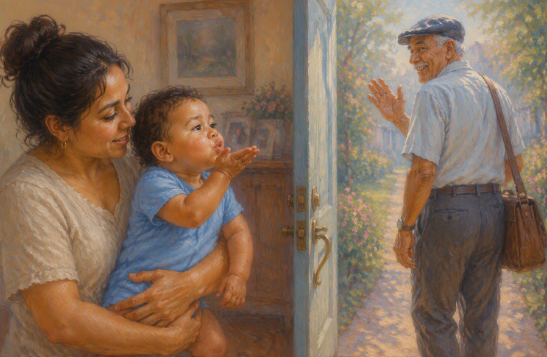
Most babies begin blowing kisses at around 12 to 14 months, though the timing varies from baby to baby—some surprise their families a little earlier, and others take a few extra months.
It is one of the sweetest gestures your baby will learn. But a blown kiss is more than adorable: it is a small sign that your baby is watching you, remembering what they see, and learning to send a message to another person on purpose. In other words, it is early communication in action.
When Do Babies Start Blowing Kisses?
Many babies start blowing kisses somewhere between 12 and 14 months, often around the same time they are learning to clap and wave.
There is a wide, completely normal range. Your baby is not “behind” if they blow their first kiss at 16 months, and they are not “ahead” if they do it at 11 months. Gestures develop gradually, built on months of watching and interacting with you long before that first real kiss appears.
Timing also depends on your family. A baby whose family blows kisses at every goodnight and every video call has lots of chances to see the gesture—so they often learn it sooner. A baby who rarely sees it simply has fewer opportunities to copy it. The gesture is learned, not automatic.
What a First Blown Kiss Really Looks Like
Blowing a kiss is actually several little steps stitched together: bring your hand to your mouth, make a kissing sound, then move your hand outward toward someone. Your baby will usually master these one action at a time, so early attempts often look partial—and that is exactly how it should go.
At first your baby may:
- put their hand on their mouth but forget to move it away
- move their hand toward you without touching their mouth first
- make a kissing sound with no hand at all
- wave and “kiss” at the same time, because the gestures are still blurry
Every one of these is a wonderful early try. Respond warmly to each attempt—your delight is what makes your baby want to do it again.
How to Teach Your Baby to Blow Kisses
You do not need a lesson or a drill. Babies learn gestures through seeing them, over and over, inside moments that matter to them. The goal is simply to give your baby lots of relaxed chances to watch and copy.
Try weaving blown kisses into the natural goodbyes and goodnights of your day:
- blow a kiss when someone leaves the house
- blow a kiss at the end of a video call with grandparents
- blow a kiss goodnight—to your baby, and to a favourite stuffed animal
- blow a kiss when you drop your baby at daycare
Keep it simple and slow. Say, “Blow Grandma a kiss!” and demonstrate the whole gesture clearly. You can gently guide your baby’s hand from their mouth outward while you make the sound, then celebrate the result. If your baby is not interested, that is fine—just keep modelling it cheerfully and try again another day. Your baby may watch for weeks before doing it on their own, and then do it when you least expect it.
Where Blowing Kisses Fits in the Bigger Picture
Blowing kisses is one of many early gestures—alongside waving, clapping, pointing and giving—that babies use to communicate before they have words. These gestures tend to appear across the first and second years, roughly in the same window.
If you would like the full timeline for the other gestures—when babies wave, clap and point, and how to encourage each one—see the companion guide: When Do Babies Clap, Wave and Point?
Researchers have also found links between the gestures children use early on and their later language development. That is part of why a blown kiss is worth celebrating: it is a genuine communication skill, not just a party trick.
What If My Baby Isn’t Blowing Kisses Yet?
One gesture arriving late is usually nothing to worry about. Babies develop at their own pace, and many happily skip a gesture for a while, or learn them in an unexpected order—your baby may point at every dog in the neighbourhood but show no interest in blowing kisses for months.
Rather than watching a single gesture, look at your baby’s communication as a whole. Are they finding new ways to get your attention? Do they share smiles and enjoyment with you? Are they reaching, showing, giving, waving or pointing? Are new sounds and expressions appearing over time?
That said, gestures give helpful information about development. If your baby is not using gestures such as reaching, showing, giving, waving or pointing by around 12 months, or you have concerns about eye contact, social interaction or communication, it is worth talking with your child’s healthcare provider. You do not need to wait to ask questions—an early conversation can offer reassurance or helpful support when it is needed.
A Thought from Cheryl
The ages in this article are guidelines, not deadlines. In more than forty years of working with little ones, I saw babies arrive at these milestones in every possible order, on their own perfect timelines.
So, keep blowing kisses at bedtime and on video calls, even while your baby is only watching. Every kiss you send is a small, joyful lesson that connecting with the people you love feels good. One day, often when you least expect it, they will send one right back.
Frequently Asked Questions
What age do babies blow kisses?
Most babies begin blowing kisses at around 12 to 14 months, though some do it earlier and others later. It often appears around the same time as clapping and waving.
Is blowing kisses a developmental milestone?
Yes—it is a meaningful early gesture. It shows your baby can watch a movement, remember it, coordinate their body to copy it, and use it to send a message to another person, all of which support later language development.
How can I teach my baby to blow kisses?
Model it often in real goodbye and goodnight moments—when someone leaves, at bedtime, at the end of a video call. Demonstrate slowly, gently guide your baby’s hand from their mouth outward, and celebrate every attempt. Repetition in meaningful moments is what helps it stick.
My baby blows kisses but doesn’t wave yet—is that normal?
Completely normal. Babies learn gestures in their own order. Some blow kisses before they wave, clap or point. Look at overall progress rather than any single gesture.
Should I worry if my baby isn’t blowing kisses?
Usually not—one late gesture is rarely a concern on its own. But if your baby isn’t using gestures such as reaching, showing, giving, waving or pointing by around 12 months, or you have concerns about communication or social interaction, check in with your child’s healthcare provider.
The Bottom Line
A blown kiss means far more than “how cute.” It means your baby is watching you, learning that a small movement can carry a big message—“I love you”—and choosing to send it to you on purpose. Long before the words arrive, that is real communication. Keep sending kisses, and one day you’ll get one back.