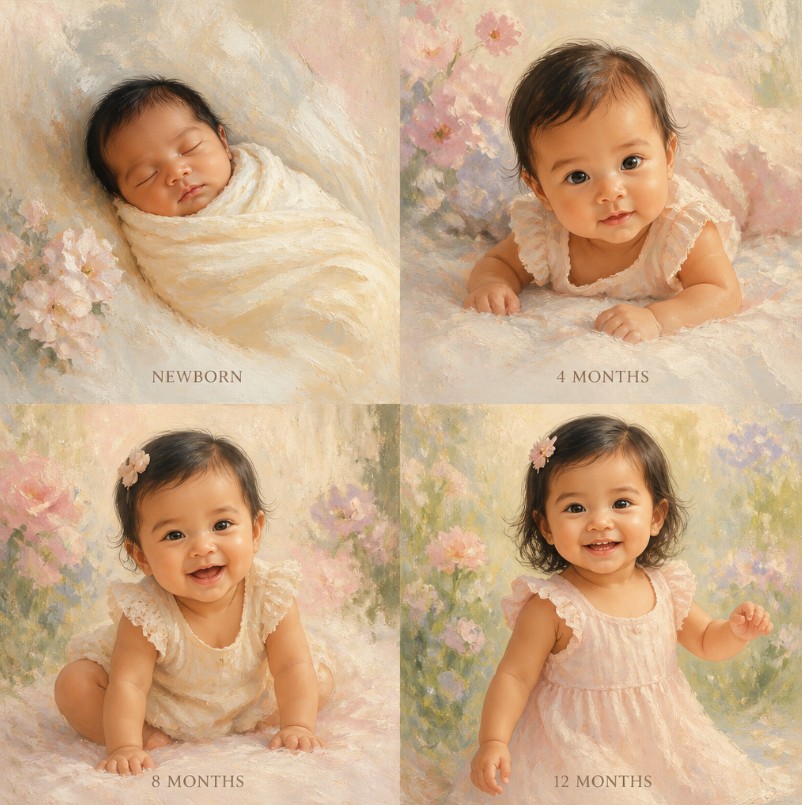
Many parents start thinking about their child’s language development when their baby is about one year old and they’re waiting for that exciting first word.
But your baby has already been learning language for a whole year!
A baby’s first word may seem like the beginning of language, but it isn’t. It’s the result of months of listening, watching, experimenting, understanding, and communicating.
Most of this early language development is invisible to parents. Your baby is learning the sounds, rhythms, patterns, and meanings of language long before they can say a single word.
There is so much to learn!
Your Baby Is Learning Language From the Very Beginning
From the day you bring your baby home, they are listening.
They’re hearing your voice. They’re becoming familiar with the rhythm and melody of the language you speak. They’re learning to recognize important voices and pay attention to sounds in their environment.
And gradually, over that incredible first year, more and more pieces begin to come together.
- From birth: Your baby is listening to voices and the rhythms and patterns of speech.
- In the early months: Your baby begins watching faces, recognizing familiar voices, cooing, and discovering that their sounds get responses.
- Around 4 to 6 months: Babbling begins to emerge, and babies experiment with speech sounds.
- Later in the first year: Babies increasingly understand familiar words, follow where you point or look, use gestures, take turns, and communicate intentionally.
- Around the first birthday: First words may appear—but they are the result of all that earlier learning.
Your Baby’s Brain Is Incredibly Busy
Here’s something amazing: The formation of neural connections related to language peaks at around 7 to 9 months of age!
Your baby isn’t even talking yet, but their brain is incredibly busy learning the sounds, patterns, and rhythms of language.
By one estimate, more than one million neural connections are formed every second during the early years. Your baby may look like they’re simply lying on the floor watching you fold laundry, but an incredible amount of learning is taking place.
They’re listening to your voice. Watching your face. Hearing the sounds around them. Beginning to recognize familiar words and routines.
Language learning is already well underway.
You Don’t Need to Teach Your Newborn
As a brand-new parent, you may feel overwhelmed by the enormous responsibility of helping this tiny person grow and learn.
Give yourself a break.
You need time to recover, get to know your baby, and find some kind of routine—which will inevitably keep changing anyway!
During those first weeks and months, sleep as much as you can, meet your baby’s physical needs, cuddle them, and talk softly when it feels natural.
Don’t worry about activities. Recover. Get to know your baby. Talk naturally. That’s enough.
You do not need to spend your days doing special language activities with your newborn. Your voice, your face, and your loving responses are already giving your baby opportunities to learn.
Talk About Your Everyday Life
As you and your baby get to know one another, simply begin talking about what you’re doing throughout the day.
You can talk about doing the dishes, going to Grandma’s, getting groceries, riding in the car, having a bath, changing diapers, getting ready for bed, waking up in the morning, or watching the puppy.
You don’t need to come up with clever things to say. Just talk.
Your baby is also learning to notice sounds all around them—the dog barking, cars going by, a siren, rain hitting the window, the dishwasher running, or the hum of a fan or air conditioner.
At first, your baby won’t understand your words. But they’re learning to listen, and listening is one of the first steps toward understanding and talking.
Your Baby Is Learning How Conversation Works
Long before babies can say words, they begin learning the back-and-forth rhythm of conversation.
I talk. Then you talk. Then I talk again.
At first, your baby’s turn may be a smile, a wiggle, a coo, or a babbled sound. When you respond, your baby begins to discover something remarkable:
My sounds matter. When I communicate, someone responds.
You can copy your baby’s coos and babbles and then wait. Sometimes your baby may make another sound back.
There you have it—one of your baby’s very first conversations!
Your Baby Is Learning the Sounds of Language
During the first months of life, babies are remarkably sensitive to speech sounds from languages around the world. As they listen to the language or languages spoken around them, they gradually become more tuned in to the speech sounds they hear regularly.
If your baby is hearing English, for example, they’ll increasingly specialize in recognizing and producing the sounds and sound patterns of English.
Think about everything involved in eventually saying even one simple word. Your baby has to listen to speech sounds, tell them apart, remember them, figure out how to move their lips and tongue, and eventually produce those sounds intentionally.
That’s a lot of work for one little word!
Language Is More Than Words
Before your baby ever says Mama, Dada, up, or more, they’re learning many other communication skills.
They learn to look at your face for information. They begin to follow where you look or point. They take turns making sounds with you. They use gestures. They bring you things and show you interesting objects.
And all the while, they’re beginning to understand words.
Understanding language usually comes before speaking it.
By around their first birthday, many babies are beginning to understand and follow simple, familiar one-step directions. You might say:
- “Give me the spoon.”
- “Kiss the baby.”
- “Give it to Daddy.”
- “Find your shoes.”
Your baby may not understand every direction yet, but this growing ability to understand language is an important part of development. Early receptive language skills—the words and directions a child understands—help build the foundation for later language and literacy development.
What About Reading, Singing, and Playing?
Babies benefit from hearing stories, songs, nursery rhymes, and finger plays. These are wonderful ways to surround your baby with language.
You can read children’s books, look at pictures together, sing silly songs, play peek-a-boo, or do favourite finger plays.
But you don’t need to turn these moments into lessons.
You don’t have to quiz your baby, ask them to repeat words, or worry about teaching colours, numbers, letters, or shapes.
At this age, your baby is learning something much more fundamental: how communication works.
They’re learning that voices have meaning. Faces give information. Sounds get responses. Gestures communicate messages. Words represent people, objects, and actions.
That’s an enormous amount of learning!
And Then Comes That First Word!
At around 12 months—give or take a couple of months—many babies say their first recognizable word.
It may seem as though talking has suddenly begun.
But it hasn’t.
That first word is the result of everything that came before it: months of listening to your voice, watching your face, taking turns with sounds, recognizing familiar words, following gestures, communicating without words, and gradually figuring out how language works.
So, when do babies start learning language?
Very, very early!
One Thing You Can Do Today
You don’t need an elaborate language program. Just meet your baby where they are right now.
- From birth: Talk to your baby in soothing, melodic tones.
- In the early months: Talk about what you’re doing throughout the day.
- Around 4 to 6 months: Respond to your baby’s coos and babbles. Copy their sounds and wait to see if they respond.
- Later in the first year: Read, play, sing, rhyme, and enjoy finger plays together.
- Around the first birthday: Play simple games where you ask your baby to give you a familiar object—and celebrate when they do!
Keep it fun. Follow your baby’s lead. A few happy moments of connection throughout the day are plenty.
A Thought from Cheryl
I mentioned earlier that more than one million neural connections are formed every second during the early years.
But your baby’s brain doesn’t develop in isolation.
Every time you talk, sing, play, rhyme, read, smile, respond to a babble, or share a moment of connection with your baby, you’re giving them experiences that help build the foundation for communication.
You truly are your child’s first and most important teacher.
And the wonderful thing is that you don’t need special toys, expensive programs, or hours of structured activities to do it.
Much of the most important language learning happens during ordinary moments with you.
The Bottom Line
Babies are learning language long before they start talking.
It may feel overwhelming to think about everything your baby has to learn, but you don’t need to fill every waking moment with activities or turn your home into a classroom.
A few enjoyable moments throughout the day—talking, smiling, singing, playing, reading, and responding to your baby—can help build the foundation for language.
That first word may feel like the beginning.
But by the time your baby says it, they’ve already been learning language for a whole year.