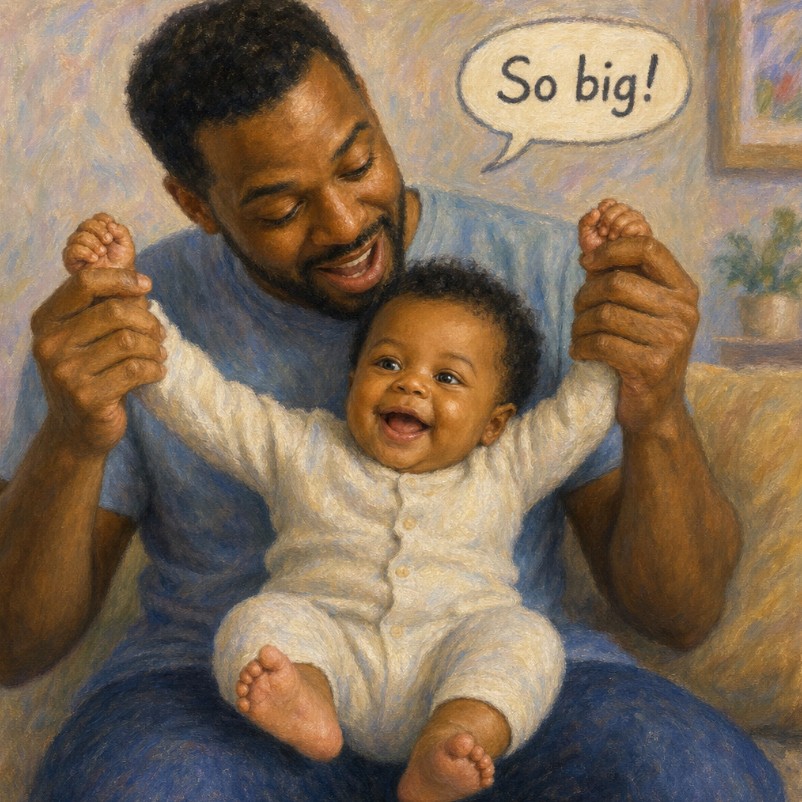
Parents with infants under six months of age are often overwhelmed with new routines and sleep deprived. Feeding, diaper changes, naps, and simply trying to figure out your new life can easily fill an entire day. You may even wonder, “Should I already be doing activities to help my baby’s development?”
The good news is that you don’t need fancy toys, expensive programs, or hour-long lessons. During the first six months of life, your baby learns best through everyday interactions with you. (When you do reach for a toy, see my guide to toys for language development for what actually helps.)
Some parents ask, “Is there such a thing as baby language?” Others wonder, “When do babies start babbling?” and still others wonder, “What kinds of things to do with infants that are actually helpful?”
When I talk about baby language, I’m not referring to “baby talk” like goo-goo or ga-ga. I’m talking about the communication skills babies develop long before they say their first words. Looking at faces, listening to voices, smiling, cooing, taking turns making sounds, recognizing gestures, and learning what words mean are all part of baby language. To quickly answer the question, “When do babies start babbling?” — you can expect your baby to babble using some consonant sounds between four and six months. Before that time babies are cooing using mostly vowel sounds. While both of these milestones are important, there are many others that will form the foundation of later communication.
While infant speech development isn’t really about speaking yet, there are many simple infant activities you can do that prepare your baby’s brain for language and speech when the time is right.
Your Baby Is Learning More Than You Think
It is amazing how many skills babies learn during their first year of life.
Movement Skills
- Roll over
- Sit independently
- Crawl
- Feed themselves
- Walk
Communication Skills
- Listen to voices
- Coo and babble
- Learn who the important people are in their lives
- Understand what words mean
- Say their first words
Thinking & Learning Skills
- Figure out where sounds are coming from
- Tell the difference between sounds
- Follow simple routines
- Learn how objects work
- Develop memory and attention
And those are only some of the amazing things happening during the first year!
With all of this learning taking place, infants also need plenty of rest. Every new experience is helping build connections in their rapidly growing brain. Just like adults, babies need downtime to process everything they are learning.
This is why I always encourage parents not to worry about entertaining their baby every waking minute. A few happy moments here and there throughout the day are plenty. Short, enjoyable interactions are far more valuable than long activities when your baby is tired or overstimulated.
Talk Throughout Your Day
The simplest and most powerful activity you can do is simply talk to your baby.
Imagine trying to learn a new language without ever hearing anyone speak it. Babies learn language by listening to the sounds, rhythm, and melody of speech every single day.
Every word your baby hears helps build the brain pathways they will later use to understand language and eventually speak.
You don’t have to come up with anything clever to say. Simply narrate your day.
- “Let’s put your socks on.”
- “I’m pouring the milk.”
- “There’s Daddy!”
- “The water feels nice and warm.”
- “I hear the puppy barking.”
- “We’re going to Grandma’s house today.”
Your baby won’t understand every word yet, but they are learning that words have meaning and that talking is an important part of everyday life.
Talk Back When Your Baby Talks
One fascinating fact about babies is that during the first several months of life they are capable of producing sounds found in many of the world’s languages. As they continue hearing the language spoken around them, they gradually stop using sounds that aren’t part of that language.
That is one reason it is so important to respond when your baby coos or babbles.
You can imitate the sounds they make — “oooo, aaaaww, baba, guhguh” — or answer as though you are having a conversation.
- “Oh my goodness! What are you saying?”
- “You are talking up a storm today!”
- “Are we going to see Grandma today?”
- “Yes, we need to get dressed to go see Grandma!”
Even though your baby can’t carry on a conversation yet, these little back-and-forth exchanges are the beginning of conversation. Researchers often call this “serve and return.” Your baby makes a sound, you respond, and your baby learns that communication goes both ways.
Traditional Infant Activities That Build Language
Many classic baby games have been around for generations because they naturally encourage communication.
- Singing songs
- Saying nursery rhymes
- Reading to your baby
- Read children’s books
- Read your own book out loud while your baby listens
- Look at pictures together and talk about what you see
- Finger plays
- Itsy Bitsy Spider
- Round and Round the Garden
One of my favourite finger plays is Round and Round the Garden because it ends with a fun surprise.
Round and round the garden like a teddy bear…
One step… two steps…
Tickle under there!
A gentle tickle under your baby’s chin or on their tummy usually brings lots of smiles.
Other wonderful infant activities include peek-a-boo and pat-a-cake. These simple games teach babies to watch faces, anticipate what comes next, and enjoy taking turns.
Don’t Forget Tummy Time
Tummy time isn’t just good for developing muscles.
Lie down on the floor facing your baby. Smile, talk, sing songs, or place a high-contrast toy nearby. Tummy time gives babies wonderful opportunities to look at faces, listen to voices, and interact while strengthening their bodies.
Simple Sensory Experiences
Babies also learn by exploring the world through their senses. Simple sensory experiences might include:
- Feeling a soft blanket and talking about “soft” — “Oh so soft, feels nice!”
- Touching a cool metal spoon and talking about “cold” — “Ooooo so cold, brrrrr!”
- Splashing during bath time and talking about “splash” — “Oh-oh, splash!”
- Listening to birds outside and talking about “cheep” — “Hear the birds go cheep-cheep!”
- Watching leaves blow in the wind and talking about “wind” — “Oh, windy today!” (You can also bow gently to imitate the wind.)
These everyday experiences give you countless opportunities to talk about what your baby is seeing, hearing, and feeling.
Gestures Help Build Baby Language
Long before babies can use gestures themselves, they learn by watching you.
- Wave bye-bye (and gently help your baby wave)
- Point to interesting things
- Hold out your hand when asking your baby to give you something
- Blow kisses
- Reach your arms up when asking, “Do you want up?”
Babies often understand gestures long before they can copy them.
Eventually your baby may begin reaching up to be picked up. When possible, respond by picking them up so they learn that gestures communicate wants and needs. If you can’t pick them up immediately, simply explain why — “Just a minute. I’m putting the food in the fridge.” Even though they may not understand every word, they are learning that communication has meaning.
What If My Baby Isn’t Interested?
Don’t worry if your baby looks away after only a minute or two.
Young infants become overstimulated very easily and often need breaks. If your baby turns their head, closes their eyes, or becomes fussy, it simply means they have had enough for now.
Try again later. A few minutes of happy interaction is much more beneficial than trying to keep a tired baby engaged.
One Baby Language Activity You Can Try Today
If your baby is approaching six months of age, try one of these simple activities.
So Big!
Sit your baby on your lap and ask, “How big is baby?”
As you gently raise their arms over their head, say, “Soooo big!”
Eventually your baby may begin raising their own arms when you ask the question. Some babies learn this after only a few tries while others may take several weeks. As always, it isn’t a race.
Give Me Five!
Hold out your hand and say, “Give me five!”
At first, you may gently help your baby’s hand touch yours. Over time they may begin reaching out on their own.
Celebrate every little success.
A Thought from Cheryl
One thing I learned over more than 40 years as a speech-language pathologist is that every parent-child relationship is unique.
You may be an energetic parent while your baby is quiet and observant. You may be relaxed while your baby is cautious or sensitive to new experiences.
There are two people in this relationship, and together you’ll discover a rhythm that works for both of you. Recognizing your own style and your baby’s personality will help you choose infant activities that are enjoyable instead of stressful.
You also don’t need to entertain your baby every waking minute. Loving interactions throughout the day are more than enough.
Whatever you do, rest assured that every smile, cuddle, song, conversation, and game is helping build your baby’s brain and supporting baby language.
The Bottom Line
People often tell new parents, “Enjoy this time — it goes by so fast.”
While that’s certainly true, I also know that some of you may be hoping it goes by quickly because you’re dealing with colic, postpartum depression, sleepless nights, or the challenges of adjusting to life with a new baby.
If that’s you, I want to reassure you. Don’t stress.
Just by talking to your baby — or even talking around your baby — you are already helping build the foundation for language and speech.
If you only remember one thing from this article, remember this:
Your relationship with your baby is the most important activity of all.
Every cuddle, smile, conversation, lullaby, and silly face helps build the foundation for language. Right now, your voice, your face, and your love are exactly what your baby needs.