By Cheryl, Speech-Language Pathologist · 40+ years working with infants, toddlers, and preschoolers
Updated: August 2026

Here are the 10 toys I recommend most for building speech and language, sorted by age, with a quick comparison table and the toys I’d skip. I’m a speech-language pathologist with more than 40 years of clinical experience, and every pick below is simple, inexpensive, and battery-free.
Parents often ask me which toy will help their child talk. It’s a fair question — toy packaging is covered in promises: builds vocabulary, teaches first words, encourages early learning. Walk down any toy aisle and you’d think language were something you could buy. Parents also ask about toys for speech development, especially if they have a late talker. The answer is usually simpler than they expect.
After more than forty years as a speech-language pathologist, here is my honest answer: the best toys for language development are the plainest ones in the store.
And the most powerful language tool of all isn’t a toy. It’s you.
A toy can’t notice that your child is looking at the dog. A toy can’t wait an extra three seconds. A toy can’t adjust when your child doesn’t understand. Only a person can do that. What a good toy can do is give the two of you something to talk about — and that turns out to matter enormously.
This guide is really about which toys create the most opportunities for you to talk, and which ones quietly take those opportunities away.
Comparison Table: 10 Toys at a Glance
Price ranges below are rough estimates for the toy category, not specific products — $ = under $10, $$ = $10–25, $$$ = $25+.
Not one of these needs batteries. Together they’d cost less than a single talking tablet toy, and most can be found second-hand.
What Makes a Toy Good for Language
When I look at a toy, I find myself asking four simple questions.
- Is it open-ended? Can it be used in more than one way? A cloth can be a blanket for a cow. A bowl can be a hat or a bathtub. A toy that plays a song when you press a button can only ever be a toy that plays a song when you press a button.
- Does it need a partner? The best language toys are a little bit useless on your own. Play food is not much fun unless someone eats it. A ball needs someone to roll it back. That built-in need for another person is exactly what creates conversation.
- Does it connect to real life? Young children learn words for things they already know: eating, sleeping, washing, driving, falling down. A toy that mirrors your child’s day gives them words they can actually use.
- Is it quiet enough to talk over? This matters more than people think. If a toy is singing, you can’t be. If it’s talking, your child isn’t listening to you.
For each toy below, I’ve included a few things you might actually say. The toy is the excuse. The talking is the point.
Birth–12 Months
✅ Works well: rattles, a rubber duck, cloth books, a peek-a-boo cloth ❌ Skip: singing toys, light-up activity centres
Sturdy Board Books
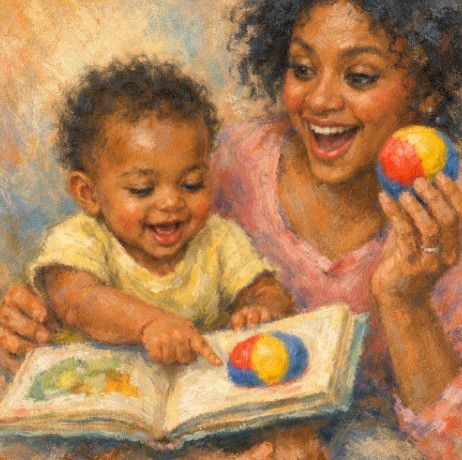
Books belong near the top of any list. Shared book reading produces more language than toys of almost any kind. You don’t have to read the words — naming, pointing, and reacting counts, and often works better with babies and toddlers.
A Small Blanket or Cloth

A dish towel is a language toy. Hiding and finding teaches that words can bring things back.
Try saying: “Where is it? … There it is!” “Bye-bye!” “Night-night.”
12–18 Months
✅ Works well: board books, farm animals, dump trucks, play food ❌ Skip: musical keyboards, electronic toys
A Teddy Bear, Doll, or Stuffed Animal
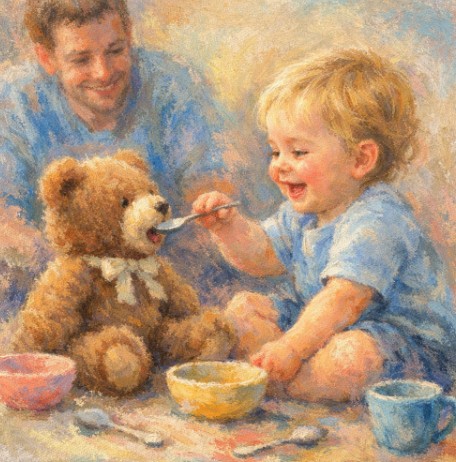
If I could only keep one, it would be this. A stuffed animal can be fed, bathed, put to bed, taken to the doctor, dropped, comforted, and found again. That covers most of a child’s daily routines — and most of their early vocabulary.
Try saying: “Teddy’s hungry.” “Uh oh, Teddy fell down!” “Night-night, Teddy.” “Where’s Teddy’s nose?”
This toy keeps working well past 18 months — see the 18–24 and 24–36 month sections below for how the play changes as your child grows.
Plastic Farm Animals
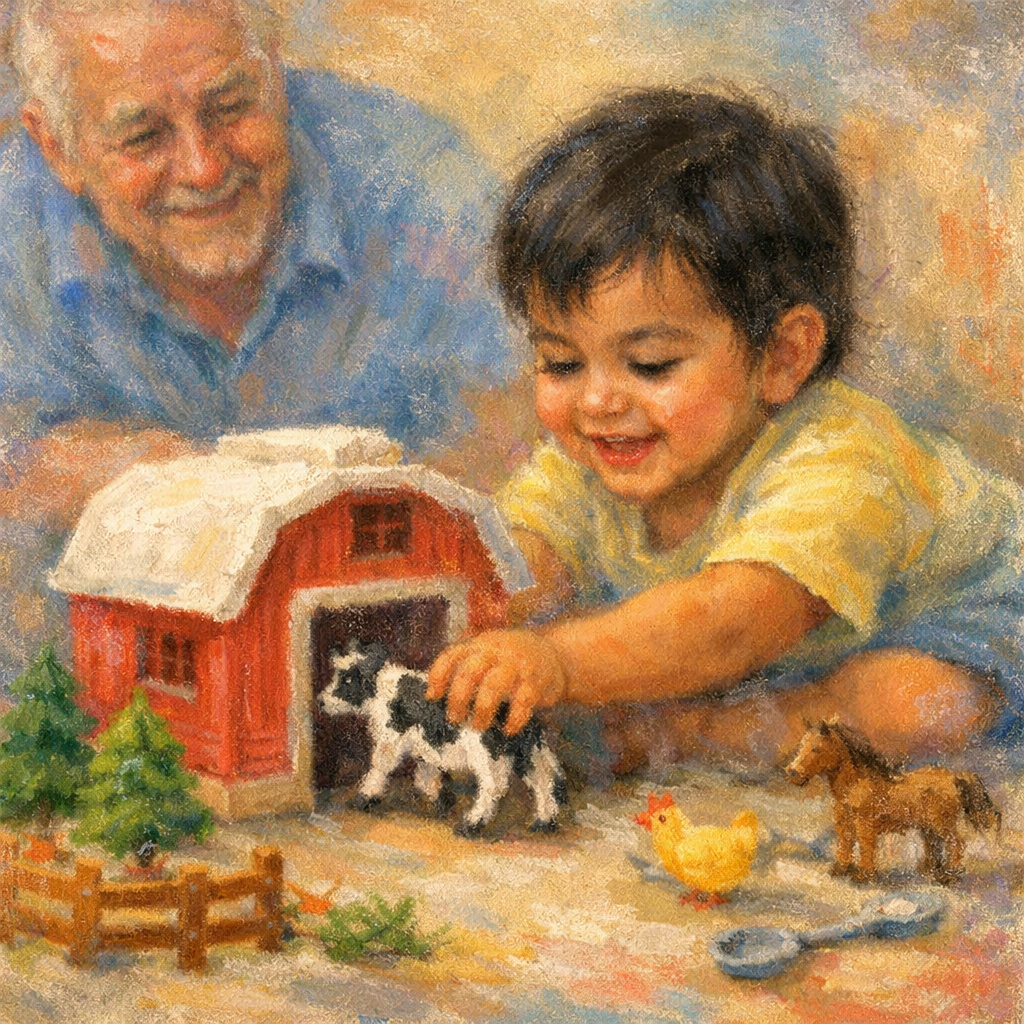
Animal sounds are often among the first sounds children attempt because they’re short, fun, and forgiving. “Moo” is much easier than “cow.”
Try saying: “The cow says moooo.” “Daddy horse, baby horse.” “Uh oh, pig fell down!”
Play Food
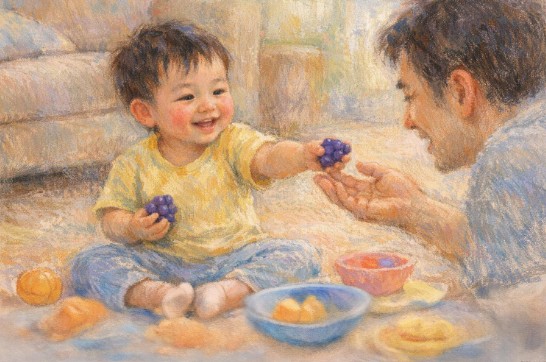
Pretend food creates offering, requesting, refusing, and sharing. These are the building blocks of conversation.
A Toy Phone
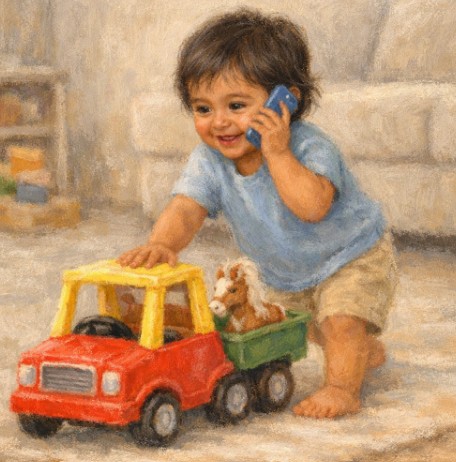
Toy phones invite sound effects and simple conversations. Sound effects are often the first step toward words.
Try saying: “Ring-ring, Hello, Nana? Are you coming over? We could have cookies? Bye-bye!”
A Toy Truck, Car, or Tractor with a Wagon
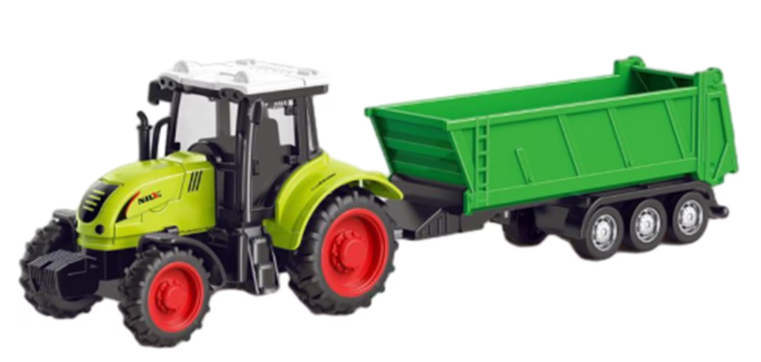
Movement creates language. Things go, stop, crash, fall, and arrive somewhere. They can haul small plastic farm animals, too.
18–24 Months
✅ Works well: tea sets, playhouses, animals, small people ❌ Skip: battery-operated “learning” tablets
A Barn or House with Small People
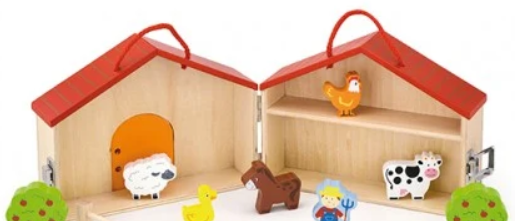
These invite simple stories. People go in and out, up and down, eat, sleep, and go places. That’s language.
Cups, Bowls, and Spoons
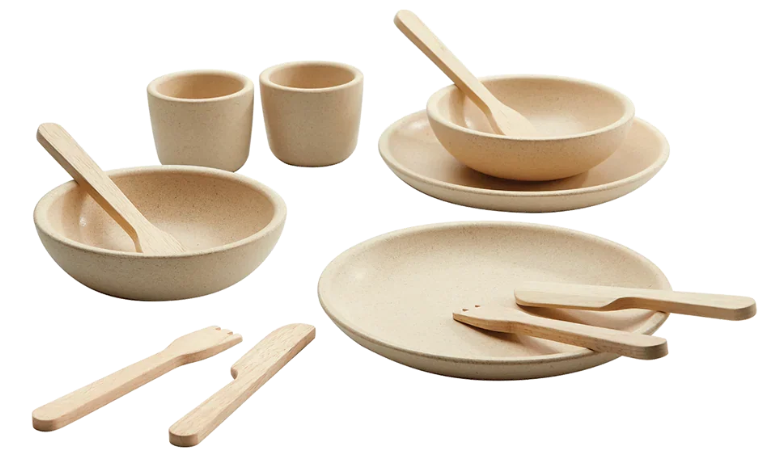
Simple — but powerful. You can feed Teddy, mix food, or pour drinks. Every action gives you something to say.
Farm animals, the teddy bear, and the toy phone (introduced above) all continue to work well at this age — pretend play just gets a little more elaborate.
24–36 Months
✅ Works well: doctor kits, play kitchens, a tractor with a wagon that attaches, nursery rhymes ❌ Skip: talking alphabet toys
Bandages and a Pretend Doctor Kit
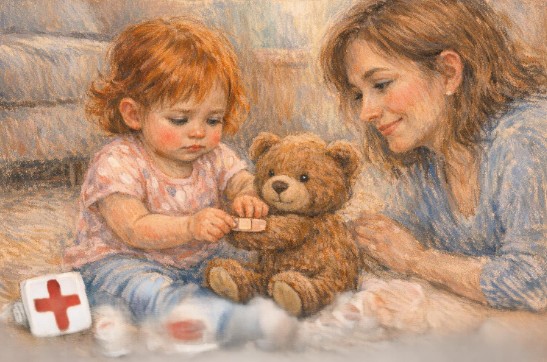
Children love “owies.” This is wonderful for feelings, comfort, and simple storytelling.
Try saying: “What happened?” — then let your child tell (or show) you the story before you help patch Teddy up.
Cups, bowls, and spoons (play kitchens) and a tractor with a wagon that attaches also fit well here — the play just becomes more of a story than a simple routine.
3+ Years
✅ Works well: dress-up clothes, blocks, puppets, storybooks ❌ Skip: tablets and electronic storybooks
By three, the same four questions still apply: dress-up clothes, blocks, puppets, and storybooks are open-ended, need a partner to be interesting, connect to real life, and stay quiet enough to talk over. Look for dress-up pieces tied to real roles your child knows (doctor, chef, firefighter) rather than character costumes alone, plain wooden or foam blocks over pre-shaped building sets, and puppets with a moveable mouth that invite a back-and-forth voice. The toy itself matters less at this age than whether it still leaves room for your child to direct the story.
What to Skip
I’m not saying electronic toys are harmful. But when a toy does most of the work — talking, singing, flashing — there may be very little left for your child to do except watch.
Research has looked at this. When families used electronic toys: parents talked less, babies vocalized less, and fewer meaningful words were used. With traditional toys and books, language increased. The toys designed to teach vocabulary produced less of it.
A talking toy is a performer. Your child becomes the audience. A simple toy is an invitation. Your child has to respond.
If you want a deeper look at exactly which toys to avoid and why, see my article on toys to avoid for language development.
Two Gift Sets That Work
The Bath Time Language Kit: rubber duck, bath animals, waterproof book, washcloths. Bath time happens every day — so language does too.
Books and Pretend Play Set: board books, stuffed animal, play food. This one grows with the child.
If you’re buying a gift, you might also like my full breakdown of baby shower gifts for language development, or — if the child is turning one — my first-birthday gift guide.
Why Speech Therapists Recommend These Toys
These are the same kinds of speech therapy toys I used throughout my career: simple, open-ended toys that promote language and social development because they invite back-and-forth interaction instead of doing the talking for your child. You don’t need expensive electronic toys, flashcards, or the latest educational gadget to build your child’s speech and language skills. What your baby needs most is a caring adult — or even an older brother or sister — who will spend time talking, singing, reading, and playing with them.
How to Use These Toys: Turn Everyday Routines into Language Time
Building language doesn’t have to take hours each day. Some of the best language-building happens during the ordinary moments you’re already spending together. For five more ready-to-use routines like these, see toys that build speech through simple toddler activities.
Bath Time
Bath time is full of opportunities for language and laughter. Play peek-a-boo with the washcloth or towel, and wash body parts together using a playful voice.
“I’m going to wash your nose…now your ears…your tummy…your toes!”
Or surprise your baby by saying,
“I’m gonna get your toes!”
Pause and wait for your baby’s smile, laugh, excited kick, or little squeal before continuing. Those playful back-and-forth moments are much more than fun — they teach your baby one of the foundations of communication: taking turns.
Diaper Changes
Diaper changes don’t have to be all business. Try a simple game of “running.” Gently hold your baby’s feet and pretend they are running.
“Ready…Run! Run! Run!”
Then stop. Wait. Watch your baby’s face. Do they smile? Kick? Look at you? Squirm? Those are all ways your baby may be saying, “Do it again!” Respond by saying,
“Oh! You want more running? Here we go…Run! Run! Run!”
Without even realizing it, you’re teaching your baby that communication is a two-way interaction. They do something, you respond, and the conversation continues.
Story Time
Even very young babies enjoy looking at books. At first, your three- or four-month-old may simply enjoy hearing your voice. A few months later, they’ll want to help turn the pages. By around 10 to 18 months, many toddlers enjoy pointing to familiar pictures. You might say,
“Let’s find the puppy!” “Can you touch the ball?”
Whenever possible, show your child the real object too: “There’s the ball in your book…and here’s your real ball!” Making those connections helps children understand that words represent real objects and experiences.
Put Teddy to Bed
Lay Teddy down and cover him with the blanket.
“Oh no…Teddy is tired!” “Night-night, Teddy.” “Shhhh…Teddy’s sleeping.”
After a few seconds: “Good morning, Teddy! Time to wake up!” Repeat this little routine over and over. At first, your child will simply watch. Later they’ll help cover Teddy. Eventually they may whisper “Shhhh” or say “night-night.”
Feed Teddy
Pretend Teddy is hungry. Use the spoon to feed him.
“Oh! Teddy says he’s hungry.” “Mmmm…that’s yummy!” “Glug…glug…glug…Ahhhh!”
As you play, leave plenty of time for your child to join in. Resist the urge to do all the talking or rush through the routine. Young children need extra time to think, understand what is happening, and decide how they want to participate.
Don’t worry about making the play perfect or coming up with clever ideas. The magic happens because you are repeating the same words, phrases, and simple sentences over and over in a meaningful, enjoyable way. Repetition is one of the most powerful ways children learn language.
Remember, the goal isn’t to teach your child how to feed Teddy. The goal is to create hundreds of joyful conversations around feeding Teddy. Those conversations are what build language. The same principle applies to bath time, diaper changes, story time, and every other routine you share.
One Thing You Can Do Today
Birth to 6 months: Talk to your baby during feeding, diaper changes, dressing, and bath time. These everyday conversations are the beginning of language.
6 to 12 months: Talk or sing while you’re driving. Songs like The Wheels on the Bus encourage listening, rhythm, and early word learning.
12 to 18 months: Spend five or ten minutes each day looking at a book or playing pretend with a favourite teddy, doll, or stuffed animal. You don’t need a long lesson — a few enjoyable minutes every day make a big difference.
Frequently Asked Questions
What are the best toys for language development?
The best toys for language development are simple, open-ended ones that invite interaction: a teddy bear or doll, plastic farm animals, board books, and play food with a cup, bowl, and spoon. They work because they create opportunities for you and your child to talk, take turns, and pretend together — the real engine of language growth.
What are the best toys for speech delay or a late talker?
The same simple toys — used a little differently. Choose toys that create a natural reason to communicate: a ball that needs to be rolled back, bubbles that need blowing again, a container that’s hard to open. Then pause and give your child time to respond, even if it’s just a sound or a gesture.
What are good toys for speech therapy at toddler age?
For toddlers, look for toys that connect to real life and invite pretend play: play food, dolls or stuffed animals, toy vehicles, and simple household items. These toys encourage talking about actions, routines, and feelings — the same categories speech-language pathologists use in therapy.
Do educational or electronic toys help or hurt language development?
Usually they hurt more than they help. Toys that light up, sing, and talk on their own tend to do the communicating for the child. Studies have found that babies and parents say fewer words during play with electronic toys than with simple toys or books. A $3 stuffed animal you play with together beats an expensive gadget your child watches.
Do I need special speech therapy toys?
No. There is no such thing as a “therapy toy.” Most speech-language pathologists use ordinary toys — the same teddy bears, farm animals, and play food sets you’d find in any toy aisle. What matters is how the toy is used, not what it is.
How do toys help with language development?
Toys help most when they become props for conversation. Feeding a teddy bear, guessing what animal made that sound, or pointing to pictures in a book gives your child reasons to listen, follow directions, take turns, request “more,” and eventually use words for a real purpose. The toy is the excuse; your back-and-forth interaction is what builds the language.
Are books better than toys for language development?
For the amount of language used, books often come out ahead. Shared book reading naturally creates more talking than many toys. But the best answer is both — books and toys used together with a parent.
How many toys does a toddler need?
Fewer than most children have. A small number of simple, well-chosen toys usually leads to deeper play and more language than a large, busy toy collection.
Can everyday household items help with language development?
Absolutely. Cups, spoons, towels, boxes, and containers are often just as effective — sometimes more so — than store-bought toys. They are familiar, flexible, and easy to talk about.
What should I do if my child isn’t talking yet?
Start with simple play. Sit with your child, follow what they’re interested in, say a few simple words about it, and then pause. If you’re concerned about your child’s development, it’s always reasonable to speak with a speech-language pathologist.
Thoughts from Cheryl
In forty years, I have never once thought, that child needs a better toy. What I have thought, often, is that a child was having a lovely time — and nobody had sat down with them.
If you’re worried about your child’s talking, the answer is not in a shopping cart. Sit down. Follow their lead. Say a few simple words. Then wait.
The Bottom Line
The best toys for language development are simple, quiet, and incomplete without you. They don’t teach your child to talk. They give the two of you a reason to.