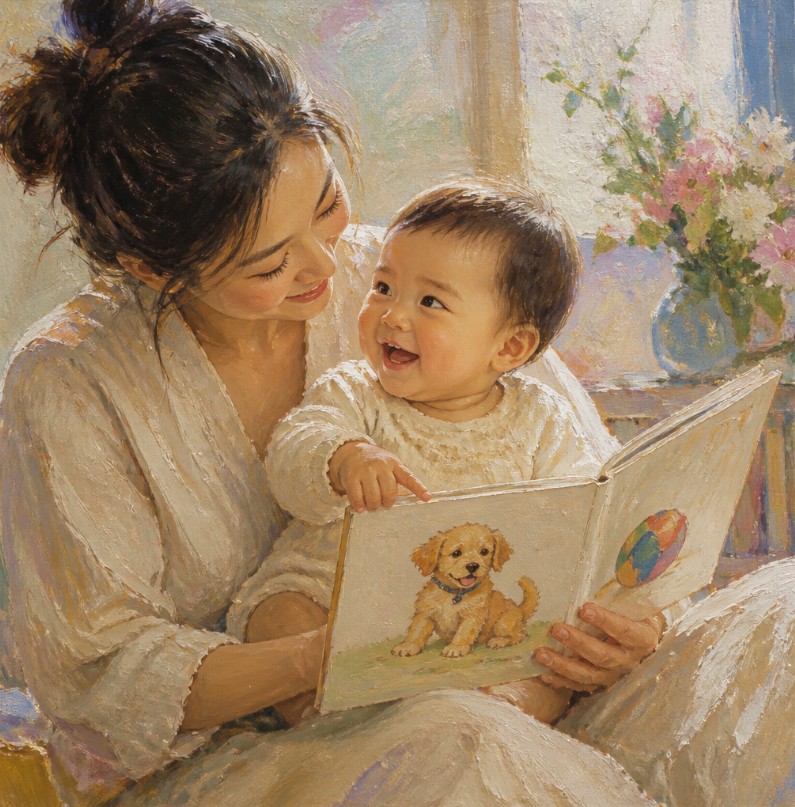
Maybe you have tried to read to your baby, and they squirmed, grabbed the book, chewed the corner or wriggled right off your lap.
That is completely normal!
Your baby is not being “naughty,” and you are not doing it wrong. Listening is a skill, and like every other skill, it grows a little at a time. Our job is simply to make listening to a story something your baby wants to be part of.
And remember, your baby does not have to sit perfectly still on your lap for book-sharing to “count.” Your baby might lie beside you, sit facing you, stand beside a coffee table with the book open, or crawl away and come back.
The goal at first is not sitting still. It is helping your baby discover that books—and your voice—are worth coming back to.
Start With You, Not the Book
Long before a baby cares about a story, they care about your voice and your face.
Sit close, snuggle your baby on your lap or lie down beside them, and let them feel safe and warm. When your baby is calm and connected to you, they are more ready to listen.
When they are hungry, overtired or overstimulated, even the best book will not hold their attention—and that is okay. Simply try again later.
Initially, your baby may think that turning the pages is what a story is. That is fine! Let them turn the pages while you try to get them excited about one picture on each page.
Use your “parentese” voice. That sing-songy, up-and-down, slightly exaggerated voice we naturally use with babies is not silly. It is exactly the kind of voice that can capture a baby’s attention and help them tune in to what you are saying.
Stretch out the fun words. Whisper. Get excited. Make a funny sound. Your voice is one of your best tools for capturing your baby’s attention—so use it!
Keep It Short and Follow Your Baby’s Lead
A four-month-old may listen for a minute. An older baby may listen for a few.
You do not have to finish the book. In fact, at first, you almost certainly won’t—and that is perfectly fine.
If your baby shows interest in a specific page, stay there and talk about it. If they want to flip ahead, flip ahead. If they want to go backwards, go backwards.
If your baby reaches for the book to hold, pat or even mouth it, that is okay too—as long as the book is sturdy and safe for them to explore. At this stage, babies are still learning what a book is and what to do with it.
Of course, if your baby is doing nothing but chewing the book, you can offer an appropriate teething toy and try the story again later!
Following your baby’s interest teaches them that books are fun and something you do together.
You Don’t Have to Read the Words
This is important: you do not have to read the words on the page.
You do not have to start on page one, read every sentence exactly as written and make it all the way to the end.
In fact, with a baby, I would often encourage you not to!
Look at the pictures and talk about whatever catches your baby’s attention.
- If there is a dog: “Dog! Woof-woof!”
- If your baby pats a picture of another baby: “Baby! Hi, baby!”
- If there is a car: “Beep-beep! Here comes the car!”
You can skip pages. Go backwards. Repeat a favourite sound five times. Make up your own words. Stay on one page for as long as your baby is interested.
At this age, sharing a book is not about getting to the end of the story. It is about looking, listening, connecting and taking turns.
Point, Name and Pause
Point to a picture and name it:
“Look, a dog! Woof-woof.”
Then pause.
That little silence is an invitation.
Even before your baby has words, they may answer with a coo, a wiggle, a look or a smile. When you respond back, you are teaching the back-and-forth rhythm of conversation:
I talk. Then you talk. We take turns.
This is real social interaction, and it is the foundation of human communication.
Do not be afraid to add lots of fun sounds. A cow can say “Moooo!” A car can go “Beep-beep!” Water can go “Splash!” A clock can go “Tick-tock!”
These fun, simple sounds are often easier for babies to notice, remember and eventually imitate than longer words.
Choose the Right Books
For babies, the book itself matters.
Choose sturdy board books they can grab and gum, with big, clear pictures, real photographs, faces, familiar objects and simple repeated sounds.
And I am going to say this strongly: I would urge you to stay away from books focused on colours, shapes, numbers and the alphabet. These concepts are far too abstract for babies.
There is plenty of time for rote academics. Babyhood is not the time. If we spend these precious baby months on rote academics like counting or the alphabet, we lose time when your baby needs to be learning vocabulary and concepts.
Babies need meaningful language connected to the people, objects, sounds, actions and experiences in their real lives. They are naturally drawn to faces, familiar objects and sounds they can hear in the world around them.
How many babies do you know who are familiar with—or interested in—aardvarks or xylophones?
Instead, look for books about things that mean something to your baby: Mommy, Daddy, Grandma, babies, dogs, cats, shoes, balls, bathtime, food and familiar routines.
Give babies language they can connect to their world.
Read the Same Book Again… and Again
It may feel boring to you, but repetition is golden for a baby.
Hearing the same words, sounds and rhythms again and again helps your baby begin to predict what comes next—and anticipation is part of the fun!
Eventually, your baby may smile before the funny sound, wiggle with excitement at a favourite page or even try to join in.
A baby who knows a book will listen harder, not less.
So, if your baby wants the same book for the fiftieth time, take a deep breath and read it again. Your baby is getting something from that repetition, even if you are more than ready for a change!
Turn Down the Competition
Background television competes with your voice for your baby’s attention.
Turn off the screen, put down the phone, and let your voice and the book be the main event.
A quiet, cozy spot helps your baby focus on the one thing you want them tuning in to: you.
Make It a Routine
Babies thrive on predictability.
A book before nap or bedtime, or a story after the morning bottle, tells your baby’s brain, “This is reading time.”
When reading happens during the same cozy moments each day, your baby begins to know what to expect. Over time, they may start to settle in before you even open the cover.
But remember, reading to your baby is not about finishing a story or sitting perfectly still.
It is about connection, your voice and a few warm minutes together every day.
Do that, and the listening will come—and so will the words.
One Thing You Can Do Today
Bring a “real” object into the story.
If you see a picture of a shoe, find your baby’s shoe. Hold it beside the picture and say:
“Look! Shoe! Here’s your shoe! Shoe-shoe! Same!”
If there is a ball in the book, bring over your baby’s ball. Let them touch it, roll it or hold it while you talk about the picture.
This helps your baby begin to understand that a picture can represent something real in their world—an important early step in symbolic thinking.
It is also fun! You are taking something flat on a page and connecting it to something your baby can see, touch, hold and experience.
A Thought from Cheryl
Although I encourage looking at pictures with babies, I prefer to stay away from phones and tablets for this activity.
The swiping of pages and fiddling with buttons can quickly become much more fascinating than talking together about one picture on the screen.
A simple book allows you and your baby to slow down. You can stay on one page. Point to something interesting. Make a sound. Wait for your baby’s response. Go backwards. Go forwards. And let the interaction unfold at your baby’s pace.
And remember to match your baby’s mood and energy. Some days your baby may happily snuggle for several minutes. Other days, you may get one page before they are off to investigate something else.
Both are okay.
The Bottom Line
Is your baby always going to want to sit for story time?
No!
Babies need to move—some more than others. The goal is not to make your baby sit perfectly still or force them to listen to an entire book.
The goal is to capture a few moments each day when looking, listening and sharing a book with you feels rewarding and fun.
Over time, those moments can grow longer because your baby discovers something important: books are enjoyable, your voice is interesting, and being with you feels good.
If your older baby or toddler shows very little interest in books, don’t panic. Some children are simply much more active than others. But if your child rarely looks toward you when you speak, does not seem interested in sharing attention with you, has difficulty engaging in back-and-forth interactions, or you are concerned about their overall communication development, talk with a speech-language pathologist.
A child’s interest in books is only one small piece of the much bigger communication picture.