Parent & Caregiver Tips · By Cheryl, a retired speech-language pathologist with more than 40 years of experience working with infants, toddlers, and preschoolers.

Want to Help Your Baby Talk? Choose These Toys Instead

Simple open-ended toys that encourage language development

Walk down the baby toy aisle and you’ll see toys that flash, sing, talk, teach letters, teach numbers, and promise to make your baby smarter. But when it comes to learning language, more bells and whistles don’t necessarily mean more learning. Sometimes the best toys are the ones that do less—so your child can do more.

When a toy does most of the work—talking, singing, flashing, and performing—there may be very little left for your child to do except push a button and watch. Yes, your child may push those buttons a few times, but after the noise and flashing lights are finished, what has your child learned?

Many of these toys promise to teach colours, shapes, numbers, the alphabet, and animal sounds. But this is not how babies and toddlers learn best.

If you have read some of my other articles, you will know that I am opposed to deliberately teaching rote skills such as colours, shapes, numbers, and the alphabet to babies and young toddlers. I don’t believe it is developmentally appropriate, and every moment spent trying to teach an unusable academic task takes precious time away from the learning babies and toddlers need most.

Babies and toddlers learn language by interacting with people. They learn by hearing stories, rhymes, fingerplays, songs, and conversation. They learn through simple play routines and by hearing adults talk to them about the world around them.

So, as I always say, the caring adult who interacts with a baby or toddler is the ultimate toy.

However, I recognize that sometimes Grandma, Auntie, or Uncle lives far away and would like to send a gift to the newest little one in the family. Fair enough! So, what should you choose?

For an Infant

Instead of sending a musical puppy that sings the alphabet, try rattle socks and wristbands with little bugs on them. These give a baby something interesting to look at and discover while a caring adult talks, smiles, and responds.

“Do you see the bumble bee?”

“The bumble bee is on your foot! Here he comes… zzzzzzzz!”

Or choose a rubber duck and a waterproof book for bath time. Bath time is a wonderful opportunity for simple words, sounds, songs, and playful back-and-forth interaction.

Rather than pop-up animals that sing and light up, choose play food that a baby can hand to an adult, who can pretend to eat it with great enthusiasm. Even a very young child can enjoy this simple back-and-forth game.

“Mmmmm! Yummy! Thank you! More please!”

For a One-Year-Old

Instead of going for a xylophone or drum, choose a set of dump trucks or diggers. Trucks can be pushed, loaded, dumped, crashed, hidden, found, and used again and again in simple play routines filled with words and sounds. They can be used to haul all kinds of things around.

“Are you giving the cow a ride?”

“Where is he going?”

“Is cow going home to the farm?”

Rather than getting the musical dancing duck, choose a sturdy board book with simple pictures. A book can be enjoyed hundreds of times, and each time offers another opportunity to point, look, listen, laugh, and share words together.

“I see a ball! I think you have a ball!”

“Where is it? Let’s go get your ball! Look — ball!”

For an 18-Month-Old

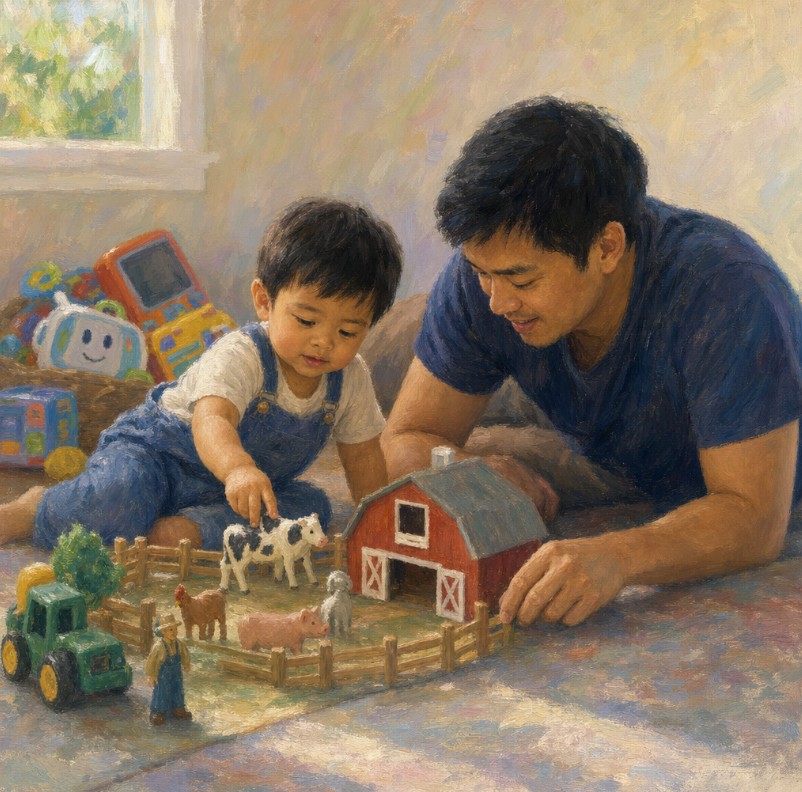
Don’t choose the fancy musical penguin that spins and tells your child animal sounds. Choose a simple farm set instead. Your child can move the animals, put them in the barn, feed them, make them sleep, and learn animal sounds from a caring adult or older sibling.

Rather than a pretend steering wheel that lights up and makes animal noises, send a small playhouse with characters and furniture or a simple tea set. These toys invite pretend play and give adults and children endless opportunities to use familiar words and simple phrases together.

“The daddy wants to watch TV.”

“Where can daddy sit? Let’s find the chair.”

For a Two-Year-Old

Rather than a piano mat, try a child’s toolbox, doctor set, or pretend store.

While the piano mat may be fun to step on several times, your two-year-old is not Tom Hanks in the movie Big. Your toddler probably won’t be playing any tunes on that piano mat and may soon tire of simply making noise.

But a two-year-old can have endless fun—often right up until age five or six—pretending to run a store, check your heart, fix broken furniture around the house, or give a teddy bear a checkup.

“Are you checking my heart?”

“How does it sound? Does it go thub-dub, thub-dub?”

These kinds of toys grow with children because there is always something new to pretend, say, and do.

One Thing You Can Do Today

If you live with or near a baby or toddler, simply talk, sing, play, rhyme, read, and do fingerplays together. Use simple toys to create little play routines that can be repeated again and again.

If you live farther away, choose gifts that encourage those same things.

Even something as simple as a book of nursery rhymes can be a wonderful gift. Busy parents may appreciate having favourite rhymes right at their fingertips without needing to stop and look them up online.

A Thought from Cheryl

There is no need to break the bank buying toys for babies and toddlers. Many simple items, such as a set of farm animals or a sturdy board book, can be found inexpensively at discount or second-hand stores.

The price of a toy has very little to do with its value for language development. What matters most is what the child—and the caring adults around that child—can do with it.

The Bottom Line

If babies and toddlers could learn language from fancy electronic gizmos, I would be the first to recommend them.

Unfortunately, all the lights and music in the world cannot hold a candle to the simple back-and-forth between a caring adult and a baby or toddler whose brain is designed to learn language through interaction.

Choose toys that leave room for your child to do something. To pretend. To explore. To take a turn. To make a sound. To share an idea.

Because the best toys don’t do all the talking.

They give your child a reason to.

More topics for parents

All parent topics Home