If you want to understand why these toys support language, you can read the full guide here.
Baby shower gifts tend to fall into two categories: things that look impressive, and things that get used every day. For language development, the second group matters far more.
What Makes a Good Gift for Language?
The best gifts fit into daily routines, encourage interaction, and don’t rely on batteries. Because language doesn’t develop from entertainment — it develops from connection.
Two Gift Ideas I Recommend Often
1. The Bath Time Language Kit
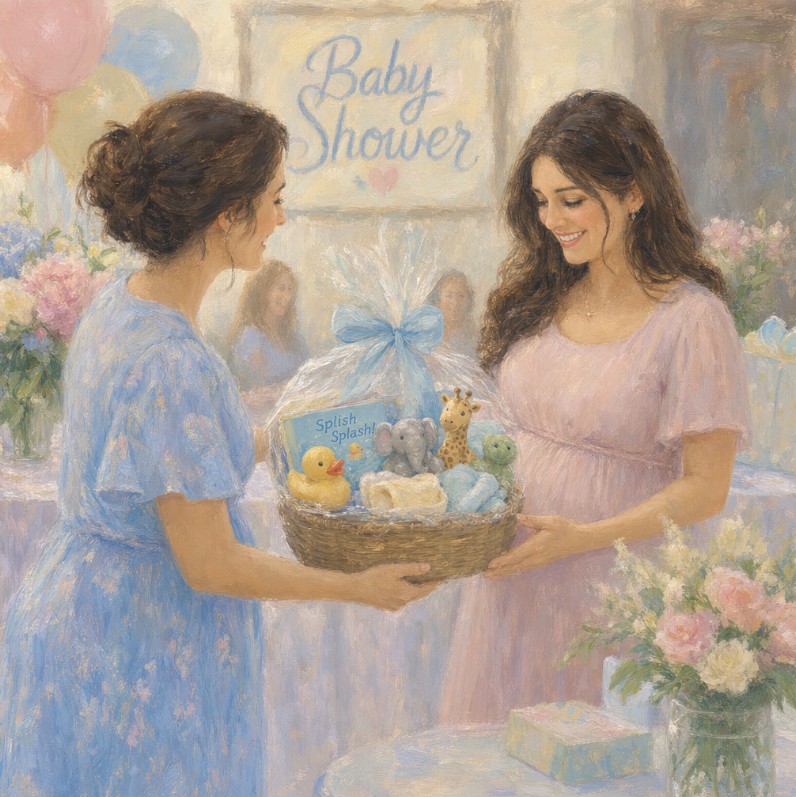
Include a rubber duck, plastic bath animals that sink and are too big to fit in baby’s mouth, a waterproof book, and a couple of soft cloths.
Bath time happens every day. That means repeated language, predictable routines, and lots of opportunities for play.
2. Books and Pretend Play Set
Include 2–3 sturdy board books, a stuffed animal, and simple play food.
This combination grows with the child. It supports naming, routines, pretend play, and early conversation.
Simple Add-Ons That Make a Difference
A small blanket for peek-a-boo and bedtime play, cups and spoons, or a toy phone or truck. These are inexpensive — but very effective.
What I Would Skip
Large electronic toys, talking tablets, and anything that “teaches words” on its own. These often reduce interaction instead of increasing it. (I go into more detail on why in my article on toys to avoid for language development.)
A Different Way to Think About Gifts
The best gift is not the one that makes the most noise, has the most features, or looks the most impressive.
It’s the one that gets used, invites play, and brings a parent down onto the floor.
The Bottom Line
If you want to give a gift that supports language: choose something simple. Choose something interactive. Choose something that leaves room for conversation.
That’s the gift that lasts.