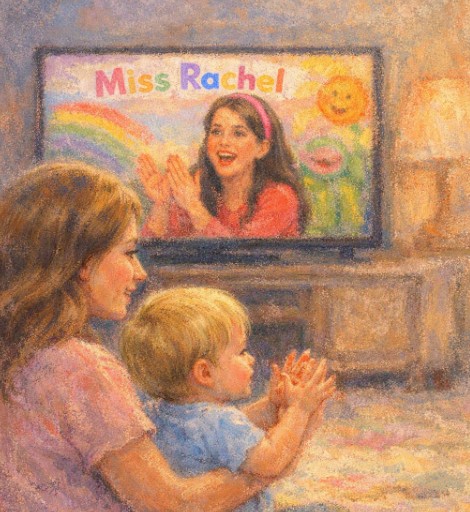
You’re trying to get ready to leave the house. Your 18-month-old is tired, on the verge of a meltdown, and you desperately need ten minutes to brush your teeth and find your keys before loading everyone into the car. You turn on Miss Rachel. Within seconds, your toddler is calm and completely focused on the screen.
As you’re rushing around, one thought keeps nagging at you:
“Is this okay…or am I doing harm?”
Screens are a real part of life these days. We all know the recommendation that children under age two have little to no screen time. But life isn’t always that simple. Maybe you have older siblings watching a favourite show, or maybe there are those occasional moments when you simply need a few uninterrupted minutes.
I’m not promoting screen time for babies and toddlers. But if you have to use a screen once in a while, let’s choose the option that is most likely to support your child’s development.
No Screen Teaches a Baby to Talk
No screen teaches a baby to talk. People teach babies to talk.
Language is built through thousands of back-and-forth interactions with caring adults—not through watching a screen.
Miss Rachel isn’t going to teach your baby how to talk, and she certainly won’t teach your child the give-and-take of real social interaction. What she can do is reinforce skills your child is already learning through everyday interactions with you.
That’s an important difference.
What Makes Miss Rachel Different? (Through an SLP’s Eyes)
Parents often ask me, “Is Miss Rachel actually good for babies?”
From a speech-language pathologist’s perspective, she’s different because she uses many of the same communication strategies we use in therapy.
- She speaks slowly.
- She pauses and waits as though expecting a response.
- She exaggerates her mouth movements so children can watch how sounds are made.
- She uses single words, short, repeated phrases, gestures, songs, and real facial expressions.
- Her voice is warm, animated, and melodic—the kind of “parentese” that naturally captures babies’ attention.
Most importantly, she talks to children rather than simply talking near them. She models the back-and-forth rhythm of real conversation, even though the child can’t actually answer her.
Why Speech-Language Pathologists Slow Down Their Speech
When we work with babies and toddlers, we don’t speak more slowly because children can’t hear us.
We slow down because it gives little brains time to process what they’ve heard, watch our mouth movements, and decide whether they’re going to respond.
Those little pauses are often where the learning happens.
Why Do Babies Love Cocomelon So Much?
Cocomelon isn’t popular because babies are “learning more.” It’s popular because it captures their attention.
Rapid scene changes, bright colours, constant music, and almost continuous movement are designed to keep young viewers engaged. Babies’ brains are naturally drawn to novelty, so many become completely mesmerized by this type of stimulation.
Being captivated, however, isn’t the same thing as learning language.
Language grows through interaction, not through watching motion or hearing music.
Where Cocomelon Falls Short for Language Development
Compared with Miss Rachel, Cocomelon contains relatively little conversational language and much more visual and auditory stimulation.
- The pace is fast.
- Scenes change rapidly.
- There is very little pausing to encourage turn-taking or imitation.
To be fair, Cocomelon does not cause speech delays. No single television show causes a language delay. The concern is that heavy passive viewing may replace the interactions that children need most for language development.
Something I Noticed During My Career
One observation stayed with me throughout my years as a speech-language pathologist.
I could often guess which preschoolers might have language difficulties simply by asking about their favourite television shows.
If a child loved action-heavy programs like Pokémon or Power Rangers, I would immediately wonder whether they might benefit from a language screening.
Not because those shows caused language delays.
Rather, children with language delays often preferred shows that relied on action, music, and visual excitement instead of conversation. Programs built around language, such as Mr. Rogers’ Neighborhood, Barney, or Arthur, were often much harder for them to follow.
The television shows weren’t the problem. They simply gave me a clue about what kinds of programs the child could successfully understand and enjoy.
Miss Rachel vs. Cocomelon: A Side-by-Side Comparison
Think of It This Way…
Think of Miss Rachel as an enthusiastic preschool teacher sitting on the floor playing with your child.
Think of Cocomelon as an exciting amusement park ride.
One invites interaction.
The other captures attention.
Language grows through interaction.
Remember: Even the Best Show Can’t Teach Language
Language develops through thousands of tiny moments with real people.
- Every smile.
- Every peek-a-boo game.
- Every diaper change.
- Every bedtime story.
- Every silly song.
- Every conversation.
No screen can replace the serve-and-return interactions that build a baby’s brain.
If you occasionally choose Miss Rachel, think of her as a tool—not the teacher.
How to Make Screen Time More Language-Friendly
If your child watches Miss Rachel, don’t let her do all the work.
Whenever possible:
- Watch together.
- Join in with the songs and gestures.
- Repeat the words.
- Pause the show and name what you see.
- Wait for your child to respond.
- Use the same songs and words later during everyday routines.
The real learning happens before the show starts and after the screen is turned off.
A Word About Screen Time Under Age Two
I agree with the recommendations from the American Academy of Pediatrics: less screen time is better for babies and toddlers.
The biggest concern isn’t the screen itself.
The concern is replacing real human interaction with screen time.
If screen time is only an occasional addition to a childhood filled with conversation, play, books, songs, and loving interactions, it’s unlikely to cause lasting harm.
When to Look Beyond Screens
If your 16-month-old isn’t talking yet, rarely points, or doesn’t use many gestures, a different television show isn’t the answer.
This is the time to talk with your healthcare provider or a speech-language pathologist.
Although it’s natural to feel anxious, an evaluation provides something incredibly valuable: answers.
You’ll either gain reassurance that your child’s development is on track or receive a plan to help your child build communication skills as early as possible.
Knowledge really is power.
Frequently Asked Questions
Is Miss Rachel good for babies?
If you have to choose a few minutes of screen time, Miss Rachel is most likely to reinforce the language work you have already done with your child.
Is Cocomelon bad for babies?
Cocomelon is more like entertainment than learning.
Miss Rachel vs Cocomelon, which is best?
If you have to use some screen time, Miss Rachel provides better language modeling and reinforcement.
Does Miss Rachel help babies talk?
Only quality interaction with humans can teach babies to talk. Shows can reinforce and expand on what you have already taught your child.
What are the best TV shows for babies learning to talk?
Humans are the best for helping babies learn to talk, but if you need to use a little screen time, choose shows where real humans are talking, where the pace is slow, and where there is lots of language versus sounds, lights, and motion.
Can screen time cause speech delay?
Short bursts of limited quality screen time itself do not cause speech or language delay. The danger is in excessive use of screens that replace human interaction. When screens are used in place of human interaction, communication and other delays become a real, serious concern.
One Thing You Can Do Today
If you do watch Miss Rachel, sit beside your child whenever you can.
- Clap along.
- Wave.
- Point.
- Sing.
- Copy the gestures.
- Pause and let your child join in.
Then keep using those same songs, words, and games throughout your day—even when the television is off.
That’s where the real learning happens.
Thoughts from Cheryl
If you’re one of those parents who has completely avoided screens during the first two years, my hat goes off to you.
For everyone else, please don’t let guilt overshadow your parenting.
You’re doing your best.
Your child doesn’t need perfect parents.
Your child needs loving, responsive parents who spend time talking, singing, reading, playing, and enjoying everyday life together.
Those ordinary moments matter far more than one television program ever could.
Bottom Line
If you need ten minutes to make supper, take a shower, or calm a tired toddler before a car ride, don’t beat yourself up over using a little screen time.
Just remember what really builds language isn’t what happens on the screen—it’s what happens after the screen is turned off.
- Every conversation.
- Every shared book.
- Every nursery rhyme.
- Every game of peek-a-boo.
Every back-and-forth interaction is helping build your child’s brain.
No screen teaches a baby to talk. People teach babies to talk.