You’ve called your baby’s name three times…nothing. They’re completely fascinated by the dog, a spoon, or a patch of sunlight on the floor. Then, five minutes later, Grandma says their name once and they turn immediately.
Is that normal?
Usually, yes.
If you’ve been calling your baby’s name and they don’t always respond, you’re certainly not alone. While many babies begin turning to their name around 5 to 7 months, and most respond fairly consistently by 9 to 12 months, occasional “not responding” is completely normal—especially when they’re deeply absorbed in exploring the world around them.
In fact, babies are supposed to become intensely interested in the people, objects, and sounds around them. Sometimes whatever they’re looking at simply wins the competition for their attention.
Another thing parents should know is that recognizing their name comes before responding to it consistently. Over many weeks of hearing their name paired with smiles, cuddles, games, and conversation, babies gradually learn, “That special word means me!” Once they make that connection, turning toward the person calling them becomes much more natural.
So, When Do Babies Respond to Their Name? A Timeline
| Age | What You’ll Likely See |
|---|---|
| 4–6 months | Your baby may quiet, smile, or turn toward your voice, but responding to their own name is usually not consistent yet. |
| 5–7 months | Many babies begin turning when they hear their own name, especially when there are few distractions. |
| 7–9 months | Responding becomes more reliable, particularly in quiet settings. |
| 9–12 months | Most babies respond to their name consistently, even when they’re busy playing. |
As I always remind parents, babies don’t read developmental charts! Milestones happen over a range of ages, and every child follows their own timeline.
Why Responding to Their Name Is an Important Communication Milestone
Speech-language pathologists pay close attention to this milestone because it tells us several important things are coming together.
When your baby responds to their name, they are showing us that they:
- hear the sound of their name
- recognize that it refers to them
- understand someone is trying to communicate with them
- can figure out where the voice is coming from
- have the motor skills to turn toward the speaker
- are interested in engaging socially
After parents’ names—and often the family pet’s name—their own name is one of the first words babies truly understand.
Responding to their name is also an early sign of joint attention, the wonderful back-and-forth sharing of attention that becomes one of the foundations for language, learning, and social communication.
Why Is This So Hard for Babies?
Responding to their name might seem simple, but it’s actually a remarkably complex skill.
Your baby has to:
- hear their name
- recognize that it is their name
- realize someone is talking to them
- locate where the voice came from
- coordinate their head and body to turn toward the speaker
When you think about all of those steps happening in just a second or two, it’s easy to understand why this skill takes months to develop.
How to Help Your Baby Learn to Respond to Their Name
From the time your baby is a newborn, say their name warmly during happy, face-to-face moments.
Smile.
Make eye contact.
Talk to them often.
Your baby’s name should become one of their favourite words to hear.
Try to pair your baby’s name with something enjoyable:
- a smile
- a cuddle
- being picked up
- a favourite toy
- a silly game
Whenever possible, reduce background noise such as television so your baby can focus on your voice.
Simple games also help.
During peek-a-boo you might say:
“Peek-a-boo! I see Zayn!”
Or while playing:
“How big is Lily? Soo big!”
Once your baby is beginning to respond, say their name once, then pause.
The waiting is important.
Give them time to process what they’ve heard and turn toward you. You don’t want to accidentally teach your baby that they don’t need to respond until you’ve called their name eight or ten times.
When they do look at you, celebrate!
Use an enthusiastic voice and a big smile.
For example:
“Nola?… There you are! What are you building? Should Mommy come play?”
“Aiden?… Do you want to swing? Wheee! Aiden is swinging!”
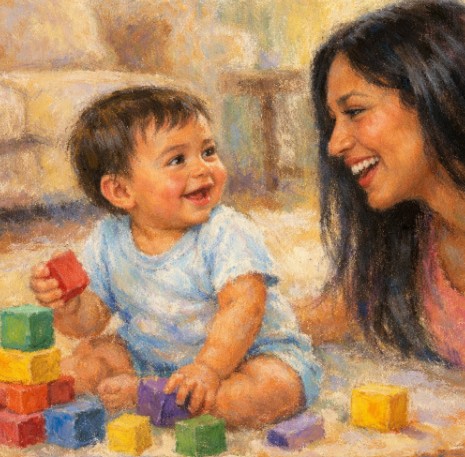
Imagine your baby happily banging blocks together. You say, “Emma!” She pauses, looks toward you, smiles, and you smile warmly and say, “There you are!” That tiny interaction may only last a few seconds, but it’s teaching your baby that responding to their name leads to fun conversations and shared attention.
Don’t worry—you won’t need to be this animated forever. You’re simply helping your baby discover that hearing their name is exciting and rewarding.
One more tip: try not to use your baby’s name only when something unpleasant is about to happen, like stopping play or changing a diaper. Balance those moments with plenty of fun experiences so your baby’s name continues to predict enjoyable interactions too.
What If My Baby Doesn’t Respond to Their Name?
Try not to become discouraged if your baby doesn’t always respond.
They may be:
- deeply interested in a toy
- watching an older sibling
- tired
- hungry
- not feeling well
- simply too young for this skill
Remember, developmental milestones aren’t set in stone.
If your baby is around 12 months old and rarely or never responds to their name—even in quiet settings when you know they can hear you—it is worth discussing with your healthcare provider.
It’s also important to seek advice if your baby previously responded to their name but has stopped.
Your healthcare provider may want to look at several areas of development, including hearing, motor skills, language understanding, and early social communication.
It would be especially important to seek advice if your baby rarely responds to their name and has:
- limited eye contact
- few gestures such as pointing or waving
- little interest in interacting with others
- limited responses to sounds in general
Remember, not responding to their name by itself does not automatically mean your child has autism. There are many possible reasons for this behaviour, which is why a complete developmental assessment is so important.
Frequently Asked Questions
When do babies respond to their name?
Many babies begin turning toward their name between 5 and 7 months, become more consistent between 7 and 9 months, and usually respond reliably by 9 to 12 months.
Does not responding to their name mean my baby has autism?
No. While consistently not responding to their name can sometimes be one sign that deserves further evaluation, there are many other possible explanations, including hearing differences, motor challenges, language delays, or simply individual variation in development. One milestone should never be used by itself to draw conclusions.
My baby ignores me when I call their name. Is that normal?
Yes. Babies who are deeply engaged with an interesting toy, watching a sibling, or exploring something new may not respond immediately. Their attention is still developing, and shifting their focus takes practice.
How can I teach my baby to respond to their name?
Use your baby’s name often during warm, enjoyable interactions. Pair it with smiles, cuddles, songs, games, and conversation. When your baby looks toward you, respond enthusiastically so they learn that responding to their name leads to positive experiences.
When should I talk to my doctor?
If your baby is not responding consistently by about 12 months, or if they have stopped responding after previously doing so, talk with your healthcare provider—especially if you also notice limited eye contact, few gestures, or reduced responses to sounds.
A Thought from Cheryl
After working with babies, toddlers, preschoolers, and their families for more than 40 years as a speech-language pathologist, I know that responding to their name is an exciting milestone for parents. When it happens, parents celebrate. When it doesn’t, they naturally begin to worry.
But remember how much your baby has to do before they can simply turn when they hear their name. They first have to learn that this special word belongs to them, understand that someone is trying to communicate with them, locate where the voice came from, and coordinate the movements needed to turn toward it.
Learning their name doesn’t happen through formal teaching. It happens through hundreds of warm, everyday moments filled with smiles, conversation, cuddles, songs, and play.
Be patient with your baby—and with yourself.
The Bottom Line
If you’re worried because your baby isn’t responding to their name yet, remember that development is rarely perfectly predictable. Some babies reach this milestone a little earlier, while others simply take more time.
Responding to their name is just one of hundreds of developmental milestones your child will achieve during the first two years of life.
Celebrate the wonderful things your baby is doing today while gently encouraging the skills that are still developing. And if you have concerns, don’t hesitate to reach out to your healthcare provider. Early guidance can provide reassurance when everything is progressing normally—and support when your child needs a little extra help.