Almost every parent of a young child has had that 2 a.m. moment.
Sometime during the day you’ve noticed your child doing something that seems a little unusual, and suddenly you’re wondering:
“Is that something I should be concerned about?”
As a speech-language pathologist, parents asked me questions like this almost every week.
Here’s the most important thing I’d like you to remember:
Don’t focus on one behavior. Look for a pattern of behaviors over time.
One behavior done once—or even for a few weeks—may mean absolutely nothing. But a group of behaviors that consistently affect how your child communicates, plays, and interacts with others deserves a closer look.
Let’s look at five behaviors parents commonly ask me about.
Is Hand Flapping a Sign of Autism?
Many toddlers flap their hands when they’re excited, especially under the age of three.
What matters more is what happens next.
Does your child flap their hands and then look at you to share the excitement?
That shared smile or glance is wonderful to see because it tells you your child is interested in sharing the moment with someone else.
If hand flapping occurs frequently, is difficult to interrupt, and happens alongside other social communication differences, it’s worth mentioning to your healthcare provider.
Is Lining Up Toys a Sign of Autism?
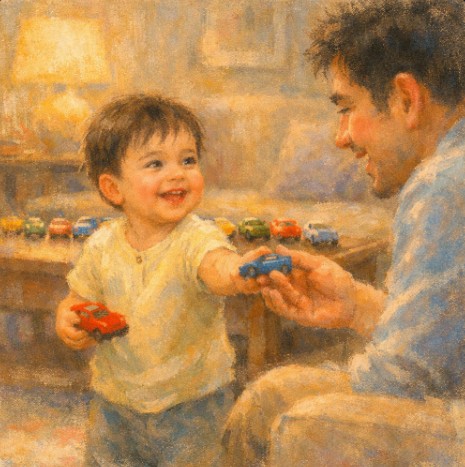
Many toddlers enjoy lining up toys.
Sorting and organizing objects by size, color, or type is actually an important thinking skill. It helps children learn about categories, patterns, and spatial relationships.
What becomes more concerning is when the play becomes very rigid.
For example:
- your child becomes extremely upset if someone moves one of the toys
- lining up objects replaces most other types of play
- pretend play isn’t beginning to emerge by about 18 to 24 months
Again, the important question isn’t whether your child lines up toys.
It’s what other behaviors you see alongside it.
Is Covering Ears a Sign of Autism?
Not necessarily.
Some children simply have more sensitive hearing than others.
Covering ears can also happen because of ear pain, fluid behind the eardrum, or simply because a noise feels overwhelming.
If your child suddenly begins covering their ears, it’s always a good idea to rule out an ear infection first.
If sound sensitivity occurs along with several other developmental concerns, it’s worth discussing with your healthcare provider.
Is Chewing Clothes a Sign of Autism?
Usually not.
Many young children enjoy chewing on things.
This is sometimes called seeking oral sensory input, and it’s quite common during the toddler years.
Some children chew because they’re still exploring with their mouths, some because they enjoy the sensation, and some because it helps them stay calm or focused.
If clothing chewing becomes a habit, many children can be redirected to safe chew toys instead.
Is Thumb Sucking a Sign of Autism?
Absolutely not.
Thumb sucking is one of the most common self-soothing behaviors in babies and toddlers.
In fact, babies have been seen sucking their thumbs before they’re even born.
Prolonged thumb sucking can contribute to changes in tooth alignment, which may affect speech in some children later on. That’s one reason I often encouraged parents to substitute a pacifier for a thumb early if possible.
But thumb sucking itself is not considered a sign of autism.
Typical or More Concerning?
Remember, no single behavior tells the whole story.
So How Do I Know If My Child Has Autism?
Truthfully, you won’t know until your child receives a complete developmental evaluation.
Rather than focusing on one unusual behavior, look for a pattern involving social communication, interaction, and play.
Some important social communication skills that many children develop during the first year include:
Social Communication
- responding consistently to their name (usually between 9 and 12 months)
- looking where you look (joint attention)
- pointing to show you something interesting
- reaching up to be picked up
- waving goodbye
- blowing kisses
Social Interaction
- looking at your face for information or reassurance
- bringing you objects to show you
- giving you toys because they want to share with you
- smiling back and enjoying simple games together
Play Skills
- pretending to feed a doll
- driving a toy car instead of only spinning the wheels
- using toys in the way they’re intended
Missing one or two of these skills doesn’t automatically mean a child has autism.
However, if you notice several social communication differences along with repetitive behaviors such as rigid play, frequent hand flapping, toe walking, strong reactions to sounds, self-injury, a very restricted diet, or running away, it’s worth talking with your healthcare provider.
What Should I Do If I’m Still Worried?
If you’re thinking,
“My child is doing some things I’d expect—but a few things worry me,”
there’s nothing wrong with asking for an assessment.
In most provinces and states, autism assessments for young children are available at little or no cost, although waiting lists are often long.
If your concerns turn out to be nothing, wonderful.
If professionals simply want to monitor your child for a while, that’s reassuring too.
And if your child is diagnosed with autism, you’ve opened the door to early intervention—which we know can make a tremendous difference.
Something You Can Do Today
6 to 12 months
Push your baby on a swing a few times.
Stop.
Wait. See if your baby lets you know they’d like another turn with a smile, movement, sound, or gesture.
12 to 18 months
Hold your child’s hand and play “Ready… Set… Go!”
Run together. Stop suddenly.
Wait. Give your child the opportunity to ask for another turn using words, gestures, smiles, or actions.
These simple turn-taking games help build social communication long before children begin talking in sentences.
A Thought from Cheryl
Those 2 a.m. Google searches usually make parents more anxious—not less.
If you’re seeing a pattern of behaviors that concerns you, talk with your healthcare provider and ask about an assessment.
Then you can stop wondering and start helping your child in the best way possible.
Whether your child is autistic or neurotypical, you’ll spend a lot less time worrying and a lot more time enjoying all the wonderful things that make your child unique.
The Bottom Line
Autism isn’t identified by one behavior like lining up toys, hand flapping, or covering ears.
It’s recognized by a pattern of differences in social communication, interaction, play, and repetitive or restricted behaviors that appear over time.
If you’re seeing a consistent pattern that concerns you, trust your instincts and seek an evaluation.
The sooner you understand your child’s strengths and challenges, the sooner you can support their development—and that’s something every parent wants.