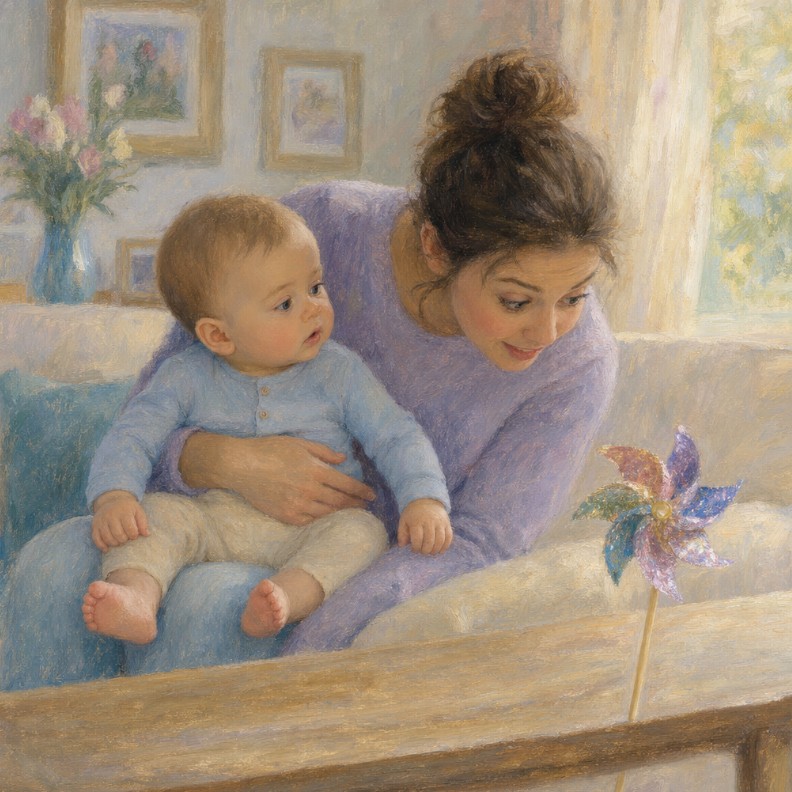
What is joint attention? Joint attention is the ability for two people to focus on the same object, event, or activity together. It typically develops between 6 and 9 months of age and becomes one of the earliest building blocks for communication, language, learning, and social interaction.
Years ago, most parents had never heard the term joint attention. Today, as more children are identified with autism and other social communication difficulties, speech-language pathologists and child development specialists recognize it as one of the most important early developmental milestones.
Although it may seem like a simple skill, joint attention lays the foundation for nearly everything that follows in communication. When children miss this important milestone, it can affect later language, play, and social development. Rather than trying to teach joint attention directly, I have found that it is often much more successful to strengthen the earlier skills that naturally lead to it.
Joint Attention Definition: Where Social Learning Begins
A simple joint attention definition is this:
Joint attention means two people are paying attention to the same thing at the same time, while each person knows the other is sharing that experience.
It may sound simple, but it becomes the foundation for almost everything that follows in communication and social interaction.
Imagine your six-month-old is sitting in a highchair and accidentally drops a spoon on the floor. The spoon disappears from sight. Your baby notices that you are looking down toward the floor with an interested expression. They follow your gaze, lean over the tray, and discover the spoon.
Without anyone giving a lesson, your baby has learned something simply by watching another person.
That is joint attention.
Children who develop strong joint attention quickly learn that other people are valuable sources of information. They discover that looking at another person’s face, eyes, or gestures helps them understand what is happening around them.
As children grow, they build on this foundation. They begin noticing facial expressions, gestures, and tone of voice. Eventually they even learn that someone can smile while teasing or use a serious voice when joking. These higher-level social skills all begin with the simple act of sharing attention with another person.
Why Does Joint Attention Matter?
Joint attention is much more than simply looking at the same object.
Before babies understand many words, they are constantly watching the people around them. They notice where you look, what you point to, how your face changes, and how your voice sounds. Those shared moments help them learn new words, solve problems, understand emotions, and eventually enjoy conversations.
That is why speech-language pathologists place so much importance on this early milestone. Long before children are speaking in sentences, they are learning from the people around them through joint attention.
The Skills That Lead to Joint Attention
Joint attention is difficult to teach directly. Instead, I prefer to teach the skills that naturally make joint attention possible.
The Back-and-Forth of Human Interaction
Before children can enjoy conversations, they first need to discover that interacting with another person is fun and worthwhile.
Some professionals call this serve and return, turn-taking, or call and response. Whatever name you use, the idea is the same. One person does something, the other responds, and the interaction continues.
For some children, especially those who would rather line up cars, flick paper, spin objects, or play independently, this can be challenging.
One of my favourite joint attention activities begins with an activity your child already enjoys.
Perhaps it’s dropping coins into a piggy bank, building a marble run, blowing bubbles, swinging, or rolling a ball.
Keep control of the materials. After a few turns, pause and wait.
Does your child reach toward you? Hold out a hand? Grab your arm? Look at you? Say “more”?
Every one of these is an attempt to continue the interaction.
These simple joint attention activities teach one of the most important lessons in social communication:
People help good things happen.
The Face Is Where the Information Is
The second skill I work on is helping children discover that faces contain important information.
This idea is sometimes misunderstood. I am not talking about teaching children to maintain constant eye contact or repeatedly saying, “Look at me!” That is not how people naturally communicate. I’m quite certain you’ve never heard those words repeated throughout a dinner party.
Instead, I want children to discover that a quick glance at another person’s face provides valuable information.
Is the game about to continue? Is someone excited? Are they waiting? Did something surprising happen?
The face tells us.
One easy joint attention activity is swinging.
Give your child several pushes, then gently stop the swing and wait.
The moment your child glances toward your face — even for just a second — let the swing go again with a huge smile and an enthusiastic “Wheee!”
Very quickly, many children begin discovering that looking at another person’s face helps them predict what happens next.
The goal isn’t eye contact.
The goal is learning that the face is where the information is.
Building Real-Life Social Skills
Once children are comfortably taking turns and looking to people for information, even more exciting things begin to happen.
They learn to follow a point. They learn to look where another person is looking. They begin sharing attention.
Now we have joint attention.
From there, pretend play becomes one of the most powerful joint attention activities you can use.
During pretend play we can introduce little “problems.” Teddy can’t find his blanket. The doll has lost her spoon. The puppy has an owie.
Instead of immediately telling the child what to do, we encourage them to look at our face for clues. They begin using another person’s expressions, gestures, and voice to solve problems and keep the play going.
These are the very same skills they will eventually use with classmates, siblings, teachers, and friends.
What If My Child Doesn’t Have Joint Attention?
Every child develops at their own pace, so don’t panic if your child isn’t doing everything listed above.
However, you may want to talk with your doctor or a speech-language pathologist if your baby:
- rarely follows where you point
- does not look where you are looking by around 9 to 12 months
- seldom looks back and forth between you and an interesting object
- seems much more interested in objects than people
- rarely shares excitement with others by showing or pointing to things
Missing one of these skills does not automatically mean autism. Children develop at different rates for many reasons. However, because joint attention is such an important foundation for language and social learning, it is worth seeking advice if you have concerns. Early intervention is always easier than trying to teach these skills years later.
My Philosophy
Therapists often use worksheets, social scripts, and social story templates to teach specific ideas. These tools certainly have a place in helping children prepare for new situations or understand difficult concepts.
However, real social understanding develops through hundreds of enjoyable interactions with real people.
When children learn to take turns, share attention, notice faces, read simple expressions, and solve little problems together during play, they build skills that are much more likely to carry over into everyday life.
After more than 40 years of working with children who have autism and social communication difficulties, I have found that strengthening these early foundations gives children the best opportunity to recognize social cues, understand what other people are communicating, and adjust their own behaviour to fit the situation.
One Joint Attention Activity You Can Try Today
If your baby is six months or older, try this simple activity.
- Place something interesting — a favourite toy, Teddy, book, or small treat — just outside your child’s direct view.
- Look at the object with an excited or surprised expression.
- Then look back at your child.
- Wait quietly to see if your child looks back at you.
- If they do, look back at the object and wait to see if they follow your gaze.
- The moment they look toward the object, bring it into view with excitement and enjoy it together.
If your child doesn’t look toward you at first, try making a gentle sound such as “Oh!”, “Uh-oh!”, or “Huh?” to capture their attention before repeating the activity.
This simple joint attention activity lets you see whether your child is beginning to follow another person’s gaze. If not, repeat it a few times each week while keeping it playful and fun.
A Thought from Cheryl
One thing I’ve learned over more than 40 years as a speech-language pathologist is that every child develops on their own timetable. Skills that seem effortless for one child may take much longer for another.
What I do know is this: early intervention matters. Some children develop joint attention naturally without any extra help. Others benefit from a little guidance and lots of playful practice. The earlier we strengthen these early social foundations, the easier it becomes to build the language, learning, and social skills that follow.
The Bottom Line
Joint attention is one of the earliest building blocks for communication, language, and social skills.
Before children can enjoy conversations, understand facial expressions, solve social problems, or play successfully with friends, they first need to discover that paying attention with another person is meaningful.
It is remarkable to think that this incredibly complex journey begins with something as simple as two people looking at the same thing together between six and nine months of age.