My Philosophy on Social Skills Worksheets, Social Scripts, and Social Story Templates for Children with Autism
2026-07-03
Many parents search online for social skills worksheets, social scripts, and social story templates because they want to help their child make friends, understand other people, and feel more confident in social situations.
I understand why. During my more than 40 years as a speech-language pathologist, I used all of these tools. They can introduce new ideas, help children understand expectations, and give parents and therapists a place to start.
But over the years, I noticed something important.
Many children could work through social skills worksheets, answer questions in social scripts, or successfully complete social story templates during therapy. They knew the "right" answers. They could tell me exactly what they should do if another child was crying or wanted to play.
Then they would go to school, the playground, the swimming pool, or soccer practice — and the same situation would happen in real life. Often, they didn't recognize it. They had learned the answers in the worksheet or the story, but they hadn't yet learned how to notice the social cues that tell us what another person is thinking or feeling.
That realization changed the way I approached social communication.
Instead of asking, "How can I teach this social rule?" I started asking, "What skills is this child missing that make social interaction difficult?"
There are many excellent programs designed to support children with autism and social communication differences. Different approaches work well for different children, and no single program is the perfect answer for everyone.
My own approach has always been to go back and strengthen the foundation.
Joint Attention: Where Social Learning Begins
One of the most important skills children typically develop between six and nine months of age is joint attention. Joint attention simply means that two people are paying attention to the same thing.
It may sound simple, but it becomes the foundation for almost everything that follows in communication and social interaction.
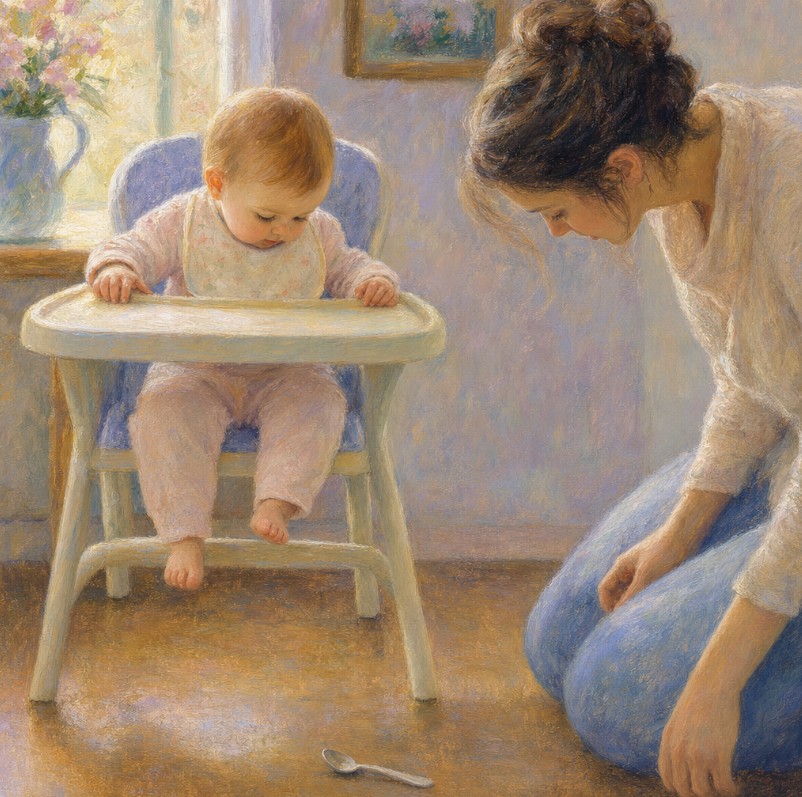
Imagine your six-month-old is sitting in a highchair and drops a spoon on the floor. The spoon disappears from sight. Your baby notices that you are looking down at the floor with an interesting expression. They follow your gaze, lean over the tray, and discover the spoon.
In that moment, they learned something astonishing simply by looking where you were looking.
That is joint attention.
Children who develop strong joint attention learn that other people are valuable sources of information. They begin to discover that looking at another person's face, eyes, or gestures helps them understand what is happening around them.
The Skills That Lead to Joint Attention
Joint attention is difficult to teach directly. Instead, I prefer to teach the skills that make joint attention possible.
The Back-and-Forth of Human Interaction
Before children can enjoy conversations, they first learn that interacting with another person is worthwhile.
Some professionals call this serve and return, turn-taking, or call and response. Whatever name you use, the idea is the same. One person does something, the other responds, and the interaction continues.
For some children, especially those who would rather line up cars, flick paper, or play independently, this can be challenging.
One simple way to encourage back-and-forth interaction is to choose an activity your child already loves.
Perhaps it's a marble run, dropping coins into a piggy bank, swinging, bubbles, or rolling a ball.
You keep control of the materials. After a few turns, pause and wait.
Does your child reach toward you? Hold out a hand? Grab your arm? Look at you? Say "more"?
Any of these are attempts to continue the interaction.
Now your child is beginning to learn one of the most important lessons in social communication: people help good things happen.
The Face Is Where the Information Is
The second skill I work on is helping children discover that faces contain important information.
This has sometimes been misunderstood. I am not talking about teaching children to maintain constant eye contact or repeatedly saying, "Look at me!" That is not a natural way to interact with another person. I'm quite certain you have never heard that phrase uttered at a dinner party.
Instead, I want children to discover that a glance at another person's face gives them useful information.
Is the game about to continue? Is someone excited? Are they waiting? Did something unexpected happen?
The face tells us.
One simple activity is to use something your child already enjoys, such as swinging.
Give your child several pushes, then gently stop the swing and wait.
The moment your child glances toward your face — even for just a second — let the swing go again with a big smile and an enthusiastic "Wheee!"
Very quickly, many children begin to discover that looking at another person's face helps them understand what happens next.
The goal is learning that the face is where the information is.
Building Real-Life Social Skills
Once children are comfortably taking turns and looking to people for information, we can build even more skills.
They learn to follow a point. They learn to look where another person is looking. They begin sharing attention.
Now we have joint attention.
From there, pretend play becomes an incredibly powerful teaching tool.
During pretend play we can introduce little "problems." Teddy can't find his blanket. The doll has no spoon. The toy puppy is hurt.
Instead of telling the child exactly what to do, we encourage them to look at our face for clues. They begin using another person's expressions, gestures, and voice to solve problems and keep the play going.
These are the same skills they will eventually use with classmates, siblings, teachers, and friends.
My Philosophy
Social skills worksheets, social scripts, and social story templates have a place in helping children learn new ideas and prepare for situations they may encounter. But real social understanding develops through hundreds of enjoyable interactions with real people.
When children learn to take turns, share attention, notice faces, read simple expressions, and solve little problems together during play, they are building skills that are much more likely to carry over into everyday life.
After more than 40 years of working with children who have autism and social communication difficulties, I have found that strengthening these early foundations gives children the best opportunity to develop the ability to recognize social cues and adjust their responses to suit the situation. As a by-product, children who can do these things also learn to regulate their behaviour based on the social and situational cues around them.
If you are looking for a structured program that builds these foundational skills step by step, visit our Pathways to Connection Social Interaction Program.