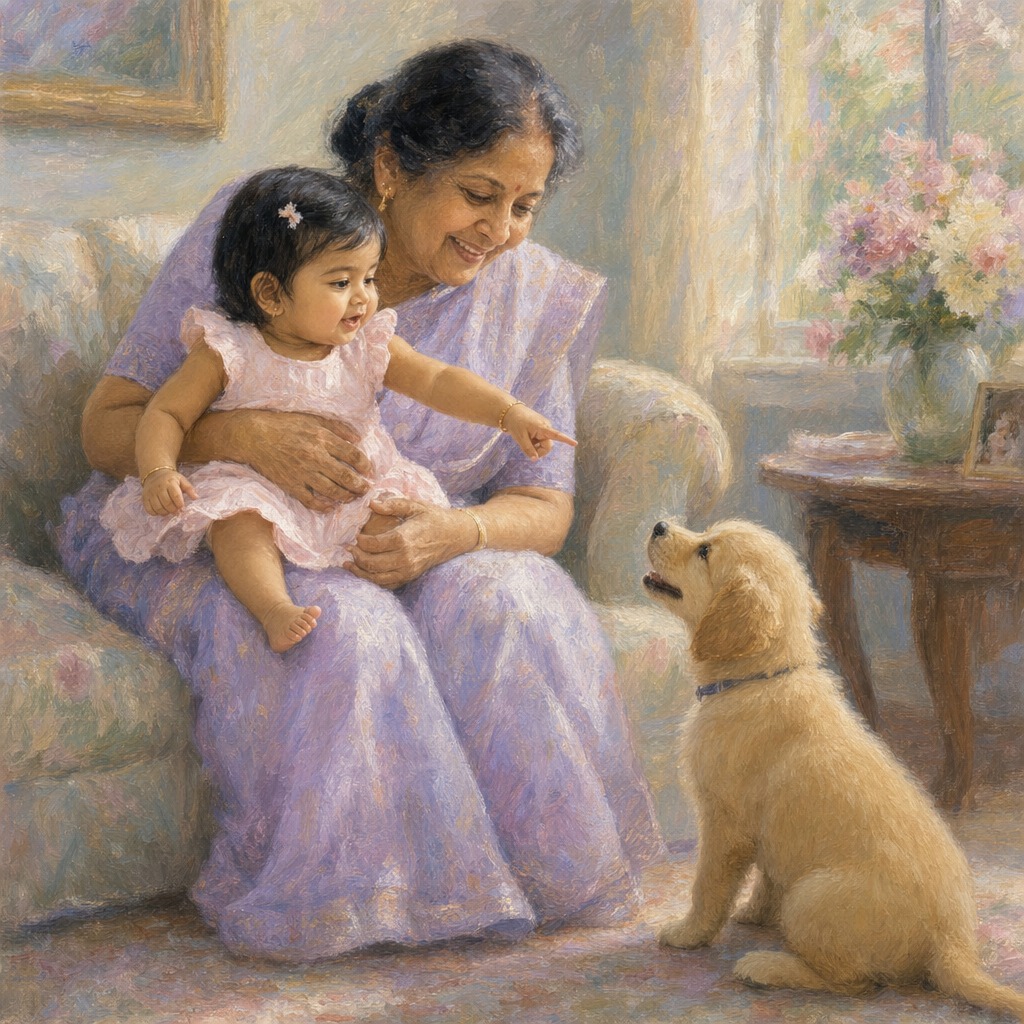
If you’ve ever wondered, “What are the signs baby will talk soon?” — you’re not alone.
This stage is exciting… and a little nerve-wracking too. You’re listening for that first real word and watching closely for clues that it’s coming.
The good news? Babies don’t suddenly start talking out of nowhere. There are clear, predictable skills that show your baby is getting ready.
As a speech-language pathologist, I look for three key prelinguistic skills — the building blocks that come before first words.
When Do Babies Start Talking?
Most babies say their first word somewhere between 10 and 14 months — but that’s just an average.
Some talk earlier. Some later.
A better question is: Is my baby showing the signs that talking is coming soon?
Let’s look at those signs.
1. Your Baby Shares Attention With You
One of the biggest signs baby will talk soon is something called joint attention.
This is when your baby:
- Looks at something (like a dog or toy)
- Then looks back at you
- Then back at the object again
It’s their way of saying: “Do you see what I see?”
Example:
Your baby spots a puppy. They look at it… then at you.
You respond: “Yes! A puppy! Look at the puppy — so soft!”
That back-and-forth moment — even if it only lasts a few seconds — is powerful. It tells you your baby is ready to share experiences, which is the foundation of communication.
2. Your Baby Uses Gestures to Communicate
Before babies use words, they use their bodies.
Look for gestures like:
- Pointing to show or request
- Reaching up to be picked up
- Waving “bye-bye”
- Holding out a hand to ask for something
These are not random movements. They are intentional communication.
When your baby uses gestures, they’ve already figured out: “I can send a message… and someone will respond.” That’s a huge step toward talking.
3. Your Baby Understands More Than They Can Say
Here’s something many parents don’t realize: understanding comes before talking.
So if you’re asking when your baby will say their first word, the real question is: How many words do they already understand?
Try this:
- “Where’s Daddy?”
- “Get your shoes.”
- “Find the ball.”
If your baby can respond — even without speaking — they’re building a strong language foundation.
Think about learning a new language yourself: you need to hear a word many times before you use it. Babies are doing the same thing — while also learning to sit, crawl, walk, and explore the world.
What About Babbling?
Babbling (like “ba-ba” or “da-da”) usually begins around 6–9 months and is another great sign.
Babbling is practice. It’s your baby experimenting with sounds — and it often comes right before real words.
A Word from Cheryl
Here’s the honest truth: you play a big role in helping your baby get ready to talk — but you don’t control exactly when it happens.
Some babies are easygoing and don’t feel the need to talk yet. Others may have challenges that make talking harder.
And here’s something important:
- Talking early does not guarantee strong communication skills later
- Talking later does not mean something is wrong
But if those early skills aren’t showing up, it’s worth paying attention.
One Simple Thing You Can Do Today
Turn everyday moments into language games.
Grab a picture book or look around your home and say:
- “Where’s the kitty?”
- “Find the ball!”
- “Where’s Daddy?”
When your baby looks, points, or touches it — celebrate! Make it fun. Make it interactive.
This builds understanding — and understanding leads to talking.
The Bottom Line
The clearest signs baby will talk soon are:
- Sharing attention with you
- Using gestures to communicate
- Understanding lots of words
These early prelinguistic skills are the real foundation of speech.
If one of these areas seems difficult for your child, trust your instincts and seek support early. A speech-language pathologist can help guide you — and the earlier you start, the better.