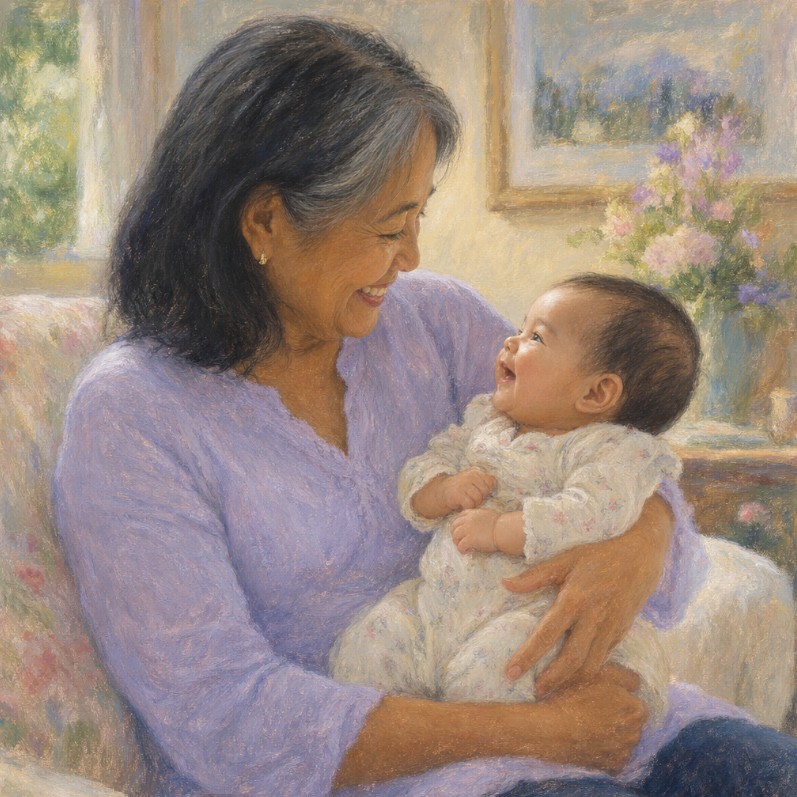
When do babies smile? A retired speech-language pathologist explains your baby’s first social smile, why it matters for communication, and simple ways to encourage language through everyday interactions.
There Is One Smile You’ll Never Forget
There is a moment that almost every parent remembers forever.
You’re talking to your baby. Maybe you’re changing a diaper or leaning over the crib. Suddenly your baby looks right at you…
…and smiles.
Not a sleepy little grin.
Not a random facial twitch.
They smiled at you.
That tiny smile is much more than adorable. It is one of your baby’s very first purposeful attempts to connect with another person. As a speech-language pathologist, I think it’s one of the most exciting milestones in early development because it marks the beginning of communication long before the first word is spoken.
During my 40-plus years working as a speech-language pathologist, excited parents would often tell me, “She smiled!”
I would smile right back because I knew something they didn’t.
“If you think you’re in love now, just wait until your baby smiles because they recognize you.”
That first social smile changes everything.
Reflexive Smiles vs. Social Smiles
Parents often ask, “What’s the difference between a reflexive smile and a social smile?”
During the first few weeks of life, babies often smile while they’re sleeping or for no obvious reason. These are called reflexive smiles. They aren’t really a response to people yet. Think of them as your baby’s nervous system practicing.
This is also why babies often smile in their sleep. As much as we’d like to believe they’re having wonderful dreams, those early smiles are usually just part of normal development.
The smile parents are waiting for is the social smile.
This usually appears around 6 to 8 weeks of age. Instead of happening randomly, your baby now smiles because they see your face, hear your voice, or enjoy interacting with you.
By about 3 to 4 months, smiling usually becomes much more frequent and turns into happy back-and-forth “conversations.”
When Do Babies Smile? A Month-by-Month Timeline
- Birth to 6 weeks: Mostly reflexive smiles that happen randomly or during sleep.
- 6 to 8 weeks: First social smiles directed toward people.
- 2 to 4 months: Smiles become more responsive during interactions.
- 4 to 6 months: Smiles are often paired with coos, giggles, laughter, and excited body movements.
Remember that these ages are averages. Every baby develops on their own timeline, and there is sooooo much for them to learn during the first year of life.
If you are concerned that your baby isn’t smiling—especially if it is accompanied by feeding difficulties or other developmental concerns—talk with your pediatrician or healthcare provider.
Why Your Baby’s Smile Matters So Much
The exciting part isn’t simply that your baby smiled.
The exciting part is that your baby smiled…
…and then waited to see what you would do.
When you smile back and say, “Well hello! Don’t you look happy! What are you smiling about?” your baby learns something amazing:
“When I smile, something happens!”
For perhaps the very first time, your baby discovers they can influence another person.
That is the beginning of communication.
Every Conversation Starts Like This
When you smile, talk, or coo and your baby smiles back, you’re already having a conversation.
It may not use words, but it follows exactly the same pattern that every conversation will follow for the rest of your child’s life.
One person does something. The other person notices. They respond. Then the first person responds again.
This wonderful back-and-forth interaction is often called serve and return, and it becomes the foundation for language, social skills, and relationships.
When you respond to your baby’s smile with words, your baby hears language at exactly the moment they are most interested in listening.
Baby: Smiles.
Parent: “Oh! Are you smiling at me? You want more splashing? Here we go… splash, splash, splash!”
Baby: Smiles again… maybe even giggles.
That’s a real conversation.
Your Face Is Your Baby’s Favourite Toy
Most social smiles happen together with eye contact.
Your baby isn’t just smiling—they’re looking for your face.
Faces are fascinating to young babies. They carefully study your eyes, your mouth, and your expressions while learning how people communicate.
When your baby smiles at you, smile right back. You’re teaching much more than happiness. You’re teaching communication.
This attention to the faces of others will become critical as your baby grows. Imagine being seven or eight years old and having a group of friends say, “You should go pull Suzie’s pigtails—she likes that!” Your child will need to look at their faces and determine whether they are being truthful or whether their suggestion is likely to get your child into trouble. It is a very subtle look that doesn’t quite match the voice—the skill that helps your child determine the truth of the situation.
It is starting now, with back-and-forth smiling and talking.
How to Smile Back (and Grow Your Baby’s Language)
You don’t need fancy toys or special activities. You simply need your face.
Move in close—about 8 to 12 inches away—so your face fills most of your baby’s view. Smile warmly. Use your happy, sing-song voice.
“Hiiiiii!”
“Peek-a-boo… I seeeeeee you!”
Then… pause. Wait. Resist the urge to keep talking. Your baby needs a chance to answer.
If your baby smiles, wiggles, coos, or kicks excitedly… smile again.
“Oh! There it is! I saw your smile!”
You’ve just had another conversation.
Don’t worry about doing this perfectly. Just enjoy each other. The smiles are the lesson.
The Best Times to Encourage Smiling
The easiest times to enjoy these little conversations are when your baby is:
- Awake and alert
- Calm and content
- Fed
- Comfortable
If your baby is hungry, exhausted, sick, or uncomfortable from a wet diaper or diaper rash, they’re probably not interested in smiling—and that’s perfectly okay.
The good news is you don’t need to schedule “smile practice.” You’re already together during diaper changes, feeding, bath time, and cuddle time. Those everyday moments are the perfect opportunities.
Whenever you interact with your baby, remember this simple pattern:
Smile · Pause · Wait · Watch · Respond.
What If My Baby Isn’t Smiling Yet?
Every baby develops at their own pace. Some babies seem more interested in movement while others become social butterflies early on.
If your baby isn’t smiling socially by about 3 months of age, or if they smiled earlier and then stopped smiling, it’s worth mentioning to your pediatrician.
There can be many different reasons, including vision, hearing, or motor challenges, or other developmental concerns. Your healthcare provider can help determine whether further evaluation is needed.
Fortunately, most babies simply get there in their own time.
Frequently Asked Questions
When do babies smile?
Most babies begin smiling socially between 6 and 8 weeks, with regular back-and-forth smiling by about 3 months.
What’s the difference between a reflexive smile and a social smile?
A reflexive smile happens randomly and isn’t directed toward another person. A social smile is your baby’s way of interacting with someone they recognize.
Why do babies smile in their sleep?
Most newborn smiles during sleep are reflexive and are considered a normal part of early neurological development.
When do babies smile at you specifically?
Usually between 6 and 8 weeks, when they begin recognizing familiar faces and enjoying social interaction.
When should I worry if my baby isn’t smiling?
If your baby isn’t smiling socially by around 3 months, or if smiling disappears after it has started, speak with your pediatrician.
One Thing You Can Do Today
After your baby’s next diaper change, before lifting them off the change table, gently hold their feet and pretend they’re running.
“Run, run, run, run, run!”
Then stop. Wait. Watch.
If your baby smiles…
“Oh! You liked that! You want more? Here we go…”
“Run, run, run, run, run!”
Those few playful seconds teach your baby that communication is fun.
A Thought from Cheryl
One of the happiest moments in my career was watching a parent realize that their baby’s smile wasn’t “just a smile.” It was the beginning of a conversation.
Every smile is an invitation.
When you smile back, you’re showing your baby that communication is joyful, that people respond to one another, and that being together is fun.
Those little moments may seem ordinary today, but they are quietly laying the foundation for every conversation your child will have for the rest of their life.
The Bottom Line
Your baby’s first social smile is much more than a heart-melting milestone. It’s one of the first signs that your baby wants to connect with you.
You don’t need special toys, flashcards, or complicated activities to encourage it.
Simply smile.
Pause.
Wait.
Watch.
Respond.
Those tiny moments of joyful back-and-forth interaction are helping your baby discover one of life’s most important lessons:
Communication is wonderful when someone smiles back.