Many parents wonder what actually happens during a speech therapy session.
They’ve heard their child will be doing speech therapy activities, but they’re not sure what that means. Will their child sit at a table? Will they play games? Will they be expected to repeat words over and over?
The answer depends on why your child is receiving speech therapy.
Speech-language pathologists (SLPs) work with children who have many different communication needs. Some children need help learning to pronounce sounds clearly, while others need support with language development, social communication, stuttering, or voice problems.
This article focuses on speech therapy activities for children who are learning to produce speech sounds more clearly.
Why Do Speech Therapy Activities Look Like Play?
One of the biggest surprises for parents is that speech therapy activities often look like play.
You may see your child playing with toy animals, bubbles, puzzles, books, cars, or board games. It might not look like “therapy” at all.
That’s actually a good thing.
Young children — especially those receiving speech therapy for toddlers — learn best when they’re relaxed, interested, and having fun. Children are much more willing to practise difficult speech sounds when the activity feels enjoyable rather than like work.
Every game, toy, or activity should have a purpose. While your child is having fun, your SLP is creating dozens of opportunities to practise a target sound.
If you’re ever unsure what your child is working on, don’t hesitate to ask. A good therapist will happily explain the goal of today’s speech therapy activities and how they fit into your child’s overall treatment plan.
How Do Speech Therapy Activities Usually Progress?
Although every child is different, speech therapy activities usually move through a series of small, manageable steps.
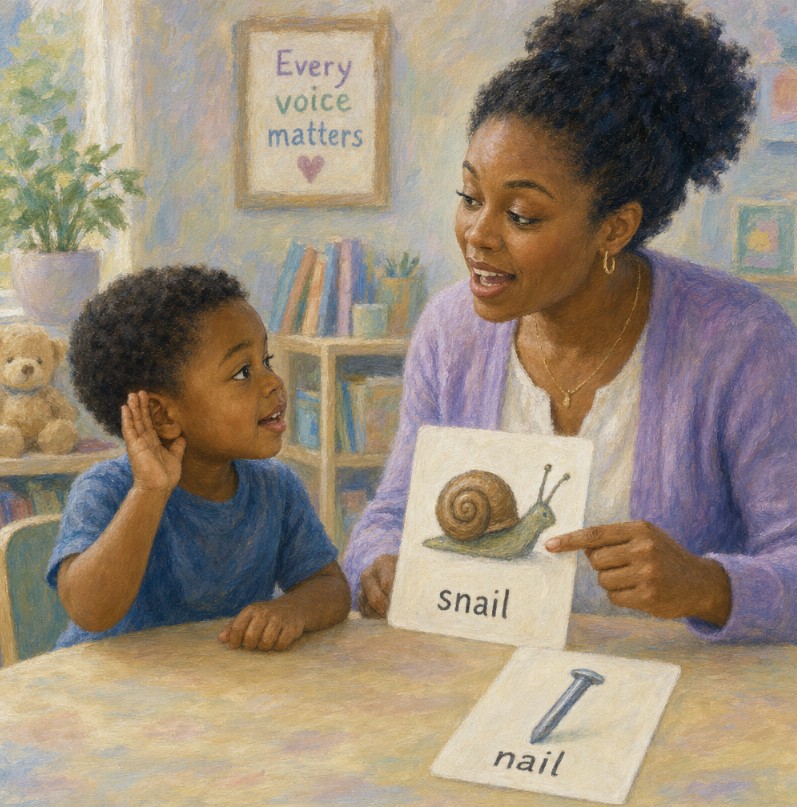
Many children begin by learning to listen for the sound they are trying to learn.
For example, can they hear the difference between “sun” and “thun”?
This listening step is important because children often need to hear the difference before they can consistently produce it themselves. It also gives them an early sense of success while saying the sound is still difficult.
As your child becomes more successful, your therapist may introduce different speech therapy exercises, such as:
- saying the sound by itself
- saying it in simple syllables
- using it at the beginning, middle, and end of words
- saying it in short phrases and sentences
- eventually using it during everyday conversation
Each step builds on the one before it.
Speech Therapy Activities for Phonological Disorders
Some children don’t have trouble making individual sounds. Instead, they have learned speech patterns that make many words difficult to understand.
For these children, speech therapy activities look a little different.
Rather than practising one sound over and over, the SLP may work on helping your child understand important sound patterns, such as:
- saying all the syllables in longer words (bumblebee, butterfly, piano)
- using consonants at the ends of words (hat, pop, back)
- saying both sounds in consonant blends (star, school, smile, snow)
- using longer continuous sounds like s, z, and f
These speech therapy exercises help children reorganize the way they use sounds, making their speech much easier for other people to understand.
Why Do Speech Therapists Use Games and Toys?
Many parents expect speech therapy to involve flashcards and drills.
Instead, you may see your child laughing while playing a game.
There’s a good reason for this.
Learning new speech patterns is hard work. Children stay engaged longer when speech therapy activities are enjoyable. That’s why therapists often use games, toys, books, bubbles, stickers, or pretend play.
You may also notice your therapist being especially animated and encouraging.
This isn’t just being playful — it’s part of good teaching. Children learn more when they feel successful and want to keep trying.
Speech Therapy at Home
One of the most important parts of progress happens between therapy sessions.
Your therapist may suggest a few speech therapy activities at home for you to practise together.
Don’t worry — you aren’t expected to become your child’s speech therapist.
Your job is simply to reinforce what your child is learning during therapy.
Most speech therapy exercises at home take only a few minutes each day. In fact, five minutes of practice every day is usually much more effective than one long practice session once a week.
Your SLP will show you exactly what to practise and how to make it fun.
Think of it like learning to ride a bike. The coach teaches the skill, but the practice between lessons is what helps it become automatic.
One Thing You Can Do Today
If your child’s therapist sends home speech therapy activities, try to make them part of your everyday routine. Practise during bath time, while driving in the car, during bedtime stories, or while playing together.
Short, fun practice sessions often lead to the greatest success.
A Thought from Cheryl
After more than 40 years as a speech-language pathologist, I’ve learned that parents sometimes leave therapy wondering, “Why are we playing this game?” or “How are these speech therapy activities helping my child?”
Please ask.
A good speech-language pathologist wants parents to understand the goals of therapy and how today’s activities fit into the bigger picture. When parents understand the “why,” they’re much more confident about practising speech therapy at home, and children often make faster progress because everyone is working toward the same goal.
If, after asking, you still don’t feel you understand your child’s therapy plan or your questions aren’t being answered, it’s perfectly reasonable to seek a second opinion. Good communication between families and therapists is an important part of successful therapy.
The Bottom Line
The best speech therapy activities don’t always look like work.
Whether your child is completing speech therapy exercises, playing games, or practising speech therapy at home, every activity has a purpose. Your therapist teaches the new skills one step at a time, and your encouragement and practice between sessions help those skills become part of everyday conversation.
When parents and therapists work together, children have the best opportunity to develop clear, confident speech.