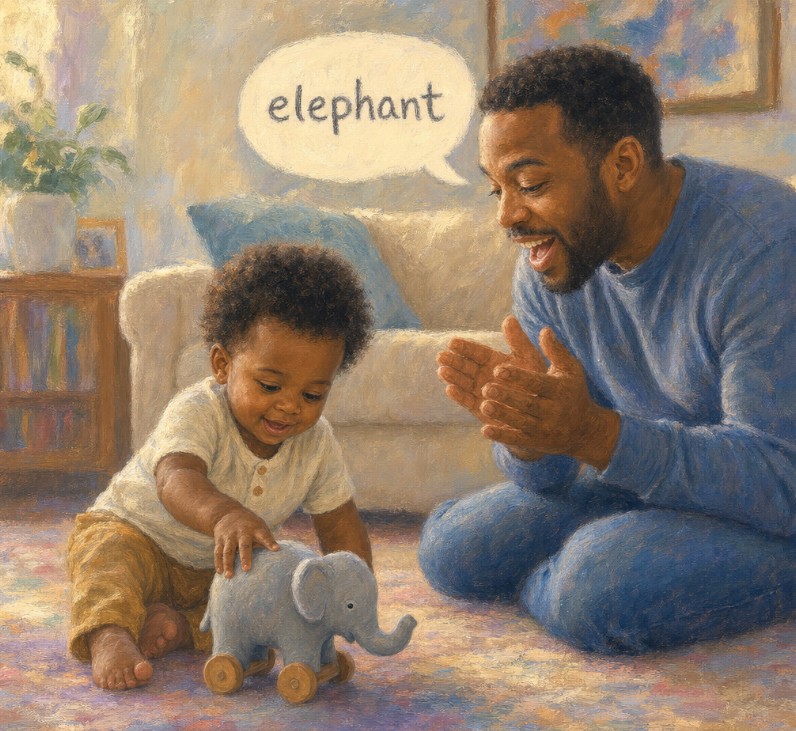
If you have a toddler who chatters constantly but leaves you—and everyone else—guessing what they just said, you’re asking a very common question: what age should a child start talking clearly? The short answer: speech becomes gradually clearer over the first four years, and a child usually isn’t fully easy to understand until around age 4. A little fuzziness before then is not only normal, it’s expected.
Here’s the key idea most parents don’t know: “talking clearly” doesn’t happen all at once, and it’s measured by how much a stranger can understand, not whether every sound is perfect. Your toddler’s little mispronunciations (“wawa” for water, “nana” for banana) are a normal part of learning to talk.
As a general guide, an unfamiliar listener can typically understand about 25% of a child’s speech at 18 months, 50% at age 2, 75% at age 3, and close to 100% by age 4. Familiar adults, like parents, usually understand quite a bit more.
Some sounds (like r, l, s, th) can stay tricky until ages 5–7 and still be perfectly normal.
“Everyone tells me he’ll grow out of it, but I can understand only about half of what he says.”
During my 40+ years as a speech-language pathologist, this was one of the most common concerns I heard from parents. This type of speech delay in toddlers—where children talk a great deal but are very hard to understand—is one of the most common referrals I received.
Sometimes a child isn’t talking very much at all. But many children have the opposite problem—they are talking all day long, yet very few people can understand what they are saying.
If this sounds like your child, don’t panic. The good news is that this is one of the most treatable speech difficulties that speech-language pathologists work with.
While you’re waiting for your speech assessment, there are several simple things you can do at home that may help your child become easier to understand.
Learning to communicate is one of the most complex things your child will ever learn to do. Speaking clearly is only one small part of that amazing process.
They learn to:
- recognize familiar people
- understand hundreds of words
- crawl, walk, run, and climb
- feed themselves
- drink from a cup
- solve problems
- play with toys
- interact with other children
…and on top of all that, they have to learn the hundreds of tiny movements needed to produce speech.
It really is an amazing accomplishment.
Every child develops at their own pace. Some children seem to learn speech sounds easily, while others need extra help.
How Babies Learn Speech Sounds
Long before babies say their first real words, they spend months practicing sounds.
You hear things like:
“bababa…”
“dadada…”
“gagaga…”
At first, babies are simply experimenting with their voices. Then something wonderful happens.
An excited parent says:
“Did you hear that? He said Daddy!”
“She said Mama!”
Suddenly those sounds have meaning. Your baby discovers that making certain sounds gets a reaction from the people they love. Before long, those playful sounds begin turning into real words.
Animal sounds and environmental sounds often become the next step.
“Moo.”
“Woof.”
“Beep beep.”
“Uh-oh!”
Although these don’t count as true words, they are wonderful practice. Your child is learning to produce sounds intentionally, and that lays the foundation for speech.
Why Is My Child So Hard to Understand?
Some children have difficulty organizing the sounds of language. Their hearing is often perfectly normal, although any child with unclear speech should have their hearing checked if it hasn’t been tested already.
Their intelligence is perfectly normal. They want to communicate. Their brains are still learning to recognize and organize all the important features of speech sounds.
Speech-language pathologists often call this a phonological disorder.
Children with a phonological disorder may:
- leave sounds off the ends of words
- replace one sound with another
- leave out syllables
- simplify longer words
For example, you might hear:
- “effent” for elephant
- “tea” for see
- “pan” for fan
- “tan” for can
- “bye” for bite
- “do” for zoo
- “cool” for school
These patterns are very common and are highly treatable.
Sometimes Parents Don’t Realize Their Child Is Already Talking
During my career, I met many children whose parents believed they had very few words.
But when I listened carefully, I discovered they were actually saying dozens—or even hundreds—of words.
The problem wasn’t that they weren’t talking. The problem was that no one could understand them.
Once we helped their speech become clearer, everyone suddenly realized just how much they had been trying to communicate all along. For many parents, it was like finally learning to understand a language their child had been speaking all along.
What Can You Do While Waiting for Speech Therapy?
Although it’s important to have your child assessed by a speech-language pathologist, there are several things you can do at home.
1. Model the Correct Word Instead of Correcting
Avoid saying, “No, that’s wrong.” Instead, simply repeat the word correctly.
Child: “Tun!”
Parent: “Yes! The sssssun is bright today!”
Your child hears the correct version without feeling criticized.
2. Help Your Child Hear Long Sounds
Some sounds can be stretched. Try exaggerating them just a little.
- ssssssssun
- ffffffffan
- zzzzzzoo
- ssssssoap
As you say the sound, slowly run your finger down your child’s arm. This gives your child both something to hear and something to feel.
3. Clap the Syllables
Some children have trouble hearing how many parts are in a word. Try clapping together:
- But–ter–fly
- Po–ta–to
- Bum–ble–bee
- El–e–phant
Keep it playful. You’re helping your child notice the rhythm of words.
4. Occasionally “Play Dumb”
This was one of my favourite strategies with families. Children usually laugh because you’re pretending that you are the one who can’t understand.
Suppose your child says: “I want toap.” Instead of immediately giving them the soap, smile and say:
“Toap? Hmm… I don’t know what toap is!”
“Ohhhh… did you mean sssssoap? My ears must not be working! I thought you said toap. We wash our hands with sssssoap!”
Notice that you’re not telling your child they said it wrong. You’re simply helping them hear the difference.
One important note: Use this strategy sparingly—perhaps once a day. If you do it every time your child talks, they may become frustrated or stop trying to communicate.
5. Keep Talking, Reading, Singing, and Playing
Even if your child is difficult to understand, don’t stop talking with them.
Read books. Sing nursery rhymes. Play pretend. Talk about what you’re doing throughout the day.
All of these activities strengthen the language system that speech is built upon. If you’re not sure where to start with pretend play, see my roundup of speech therapy toys.
Should I Correct My Child’s Speech?
Usually, no.
Most children do not benefit from constant correction. In fact, too much correction can make some children reluctant to talk.
Instead, give your child lots of opportunities to communicate and simply provide good models.
Your goal isn’t perfection. Your goal is communication.
Will My Child Need Speech Therapy?
Maybe. Maybe not.
That’s why the assessment is so important. A speech-language pathologist will determine exactly which speech patterns your child is using and develop a treatment plan that matches their individual needs.
The wonderful news is that phonological disorders respond very well to speech therapy. Children usually make excellent progress when therapy is systematic, fun, and practiced consistently at home.
One Last Thought
If your child needed glasses, you probably wouldn’t spend months worrying. You would simply make an appointment with an optometrist.
If your child couldn’t swim, you wouldn’t worry forever. You’d sign them up for swimming lessons.
Think about speech in the same way.
Don’t spend your energy worrying. Spend it taking action.
If you’re concerned that your child is difficult to understand, arrange a speech-language assessment. Whether the speech-language pathologist finds a delay, a phonological disorder, or simply reassures you that your child is developing normally, you’ll leave with something much more valuable than worry—you’ll leave with a plan.
And that’s the first step toward helping your child become a confident communicator.
Frequently Asked Questions
What age should a child start talking clearly?
Speech gets clearer gradually. A stranger can usually understand about 25% of an 18-month-old’s speech, 50% of a 2-year-old’s, 75% of a 3-year-old’s, and nearly all of a 4-year-old’s. So most children are easy for others to understand by around age 4, even if a few sounds are still imperfect.
How much of my 2-year-old’s speech should other people understand?
Roughly half. At age 2, unfamiliar listeners typically understand about 50% of what a child says, while parents usually understand more because they know the context. Lots of unclear words at this age is normal.
Is it normal that strangers can’t understand my toddler?
Yes—up to a point. Toddlers are still learning to make speech sounds, so some fuzziness is expected, especially with new or longer words. It becomes worth checking if a stranger understands less than about half of your 2-year-old, or less than about three-quarters of your 3-year-old.
When should I worry that my child isn’t talking clearly?
It’s worth mentioning to your doctor or a speech-language pathologist if your child is very hard to understand for their age (for example, hard for strangers to follow at age 3+), seems frustrated when not understood, or you notice they’re leaving off many consonant sounds. A quick hearing check is often the first step, and early support works well.
One Thing You Can Do Today
Play with sounds instead of drilling words.
Rhyme your child’s name. Rhyme the names of brothers, sisters, pets, and favourite toys. Make up silly words together. Laugh.
The goal isn’t to say every word perfectly. The goal is to help your child notice and enjoy the sounds that make up words.
A Thought from Cheryl
Many parents worry that teaching signs will delay talking. Fortunately, research shows the opposite.
You can begin teaching your child sign language (or gestures) at any time. Signs count as words, and research into families where both parents use sign language shows that children of deaf parents often “talk” earlier than their non-signing peers. In addition, signs (or gestures) can help alleviate frustration while your child’s speech catches up.
The Bottom Line
Talking isn’t a race. It’s a journey.
Every child follows their own path. Don’t compare your child with others.
Keep talking. Keep reading. Keep playing. Keep encouraging.
If you have concerns, get an assessment, follow the plan, and celebrate each new step your child takes.