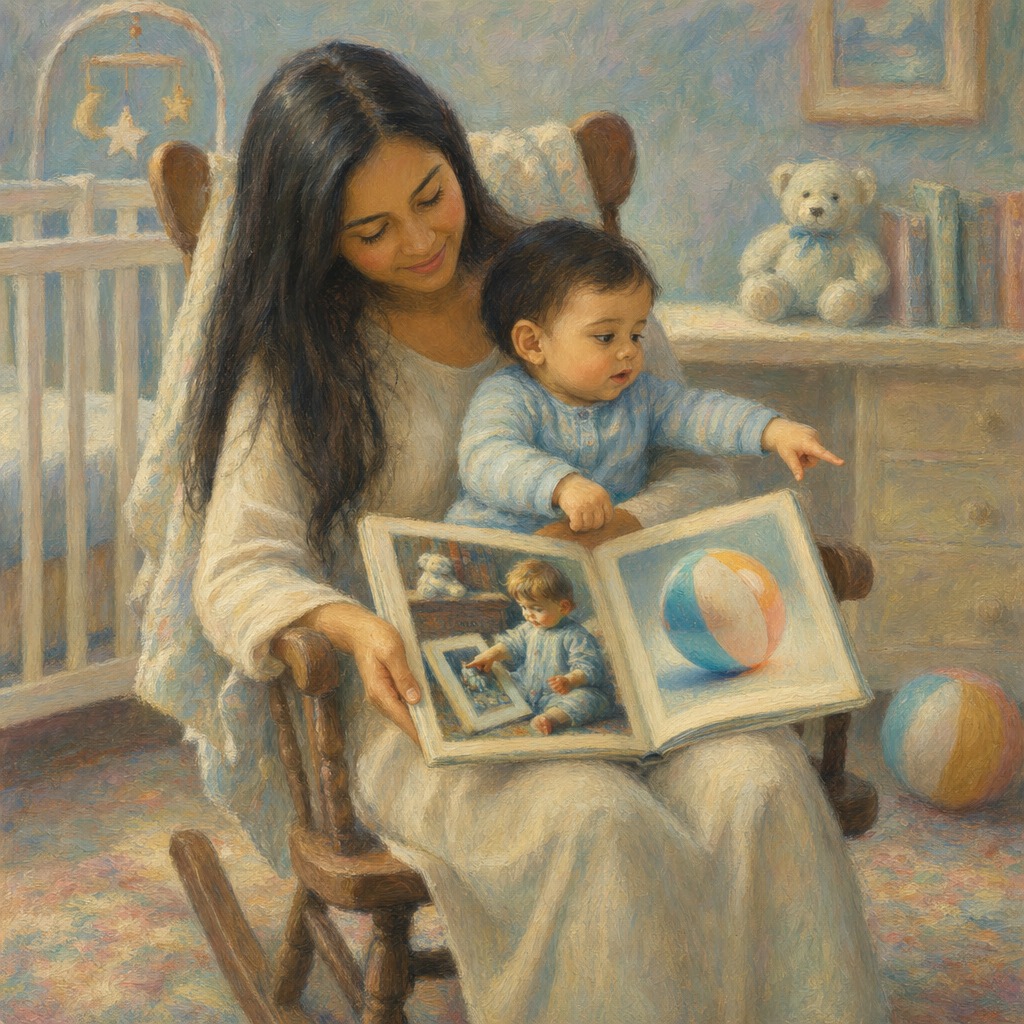
Choosing the best baby books for language development doesn’t have to be complicated. You don’t need a shelf full of expensive books or a collection of specially designed “educational” books.
The best books for babies are usually simple, sturdy and interesting enough to encourage you and your baby to look, listen, talk and interact together.
And you can start reading from the very beginning. The American Academy of Pediatrics recommends sharing books with children starting at birth, and organizations such as Reach Out and Read emphasize that shared reading provides opportunities for language-rich interaction, connection and early literacy development.
As a retired Speech-Language Pathologist, I’ve spent more than 40 years helping young children develop communication skills. I’ve learned that parents don’t need to make reading complicated.
The book matters—but what you do with the book matters even more.
What Makes a Baby Book Good for Language Development?
When you’re shopping for books for your baby, look for books that give you opportunities to talk, listen, point, imitate, laugh and interact.
Here are some things I look for:
1. Simple, clear pictures
Babies don’t need a page crowded with dozens of objects.
A simple picture of a dog gives you a wonderful opportunity to say:
“Dog! Look at the dog! Woof, woof!”
Your baby can focus on the picture while listening to the word.
2. Familiar objects and experiences
Books featuring things your baby sees in everyday life are particularly useful for language development.
Look for pictures of:
- Babies
- Dogs and cats
- Balls
- Shoes
- Cars and trucks
- Food
- Bath time
- Toys
- Family members
When a picture connects with something your baby already knows, you can connect the book to real life.
“Look! A ball! You have a ball just like that.”
3. Repetition
Babies learn through repetition. A book with repeated words, phrases, sounds or actions gives your baby many opportunities to hear the same language again.
And don’t worry if your baby wants the same book every day. Repetition is not a bad habit. It can actually make it easier for children to recognize and learn language. HealthyChildren.org specifically recommends books with repeated words or phrases and notes that continuing to read favorite books can help children learn language.
4. Opportunities to interact
Touch-and-feel books, books with simple actions, animal sounds and familiar objects can give your baby something to do with the book.
But a book doesn’t have to have flaps, buttons or textures to be interactive.
You can make almost any book interactive simply by talking about the pictures and responding to what interests your baby.
5. A book your baby enjoys
This may be the most important characteristic of all.
If your baby loves a particular book, read it!
You don’t have to constantly introduce new books just because you think your baby should have more variety.
The Best Books for Baby’s First Year
Your baby’s relationship with books will change dramatically during the first year.
A newborn may simply listen to your voice. A six-month-old may grab and chew the book. A nine-month-old may pat a picture, turn pages or point. By the end of the first year, your baby may begin participating in familiar books through sounds, gestures and actions.
The book hasn’t necessarily changed. Your baby’s ability to interact with it has.
| Baby’s Stage | What Your Baby May Be Doing | Books to Look For | How You Can Use Them |
|---|---|---|---|
| Birth–4 months | Listening, looking at faces and beginning to notice pictures | Rhymes, songs, simple pictures, high-contrast books | Hold your baby close, read slowly, sing and use an animated voice |
| 4–8 months | Reaching, grabbing, mouthing and exploring books | Sturdy board or cloth books with simple pictures | Name pictures, imitate sounds and let your baby explore the book |
| 8–12 months | Turning pages, touching pictures, pointing, making sounds and participating | Familiar objects, animals, touch-and-feel and interactive books | Point, name, imitate, pause and let your baby take a turn |
| Any age | Showing interest in familiar books | Favorite family books, photo books and books with repetition | Follow your baby’s interests and talk about what catches their attention |
Board books are particularly practical once babies begin grabbing and mouthing books. Thick cardboard pages are designed to withstand the kind of enthusiastic exploration that is completely normal for babies.
Best Books for the Early Months: Birth to About 4 Months
In the early months, your baby isn’t necessarily interested in turning pages or following a story.
That’s okay.
Your voice is the most important part of the experience.
Rhyming books, nursery rhymes and books with a simple, predictable rhythm can be wonderful choices.
Goodnight Moon by Margaret Wise Brown
Goodnight Moon is a classic for a reason. Its repetitive language and familiar objects give you plenty of opportunities to talk, point and repeat. This is a book you can use for the first two years of your child’s life!
Nursery Rhymes
This is also a wonderful time to rediscover nursery rhymes.
A book such as Nursery Rhymes Board Book (My First Book Series) by Wonder House Books gives you an opportunity to combine rhythm, repetition, facial expressions and gestures.
And remember—you don’t have to read every word exactly as it appears on the page.
You can sing the rhyme, add actions, make a funny face or pause and let your baby listen to your voice.
Books for Babies Who Are Sitting Up: About 6–12 Months
Once your baby can sit up and grab things, books become much more interactive.
Your baby may grab the book, turn pages, pat pictures, mouth the book, look at a picture, point, make sounds, or hand the book to you. All of that is part of learning how books work.
Look for sturdy books with simple pictures of familiar objects.
This is also a wonderful time for books that have one main picture or idea on each page.
For example, if the page shows a ball, you might say:
“Ball!”
“You have a ball!”
You might even get the real ball and show it to your baby. Now your baby is learning something important: this picture represents something real. That is an early symbolic concept that becomes important later when children learn that printed words also represent things, actions and ideas.
My Favourite Types of Baby Books
Rather than giving you a list of dozens of books to buy, I’d rather show you the types of books I look for when thinking about language development.
For Listening and Rhyming
- Goodnight Moon by Margaret Wise Brown
- Nursery rhyme books
- Simple books with repetitive phrases
For Learning First Words
Look for books with clear pictures of familiar objects.
My own Little Voices series includes:
- Little Voices, Big Words
- Little Voices, Big Sound
- Little Voices, First Words
- Little Voices, Me!
These books feature simple, familiar concepts that give parents plenty of opportunities to point, name, imitate sounds and connect pictures to real-life experiences.
For Learning About Sounds
Books featuring animals and familiar environmental sounds can be especially fun.
You might point to a dog and say:
“Dog! What does the dog say? Woof, woof!”
The goal isn’t to quiz your baby. The goal is to have fun making sounds together.
For Learning About Themselves
Books featuring babies and body parts can give you opportunities to connect the pictures directly to your child.
“There’s the baby’s nose. Where’s your nose?”
You can touch your baby’s nose as you say the word. This kind of picture-to-real-life connection is a simple way to make books more meaningful.
For Story and Character Books
You don’t have to limit babies to books that teach individual words. Some babies enjoy simple stories and characters, too.
One classic I particularly like is Good Dog, Carl by Alexandra Day. The story is easy to follow visually, and the pictures give you opportunities to talk about what Carl and the baby are doing.
For Touch-and-Feel and Activity Books
Interactive books can be wonderful for capturing a baby’s attention. Some examples include:
- Clap Hands by Helen Oxenbury
- Tickle, Tickle by Helen Oxenbury
- Baby Animals from the Bright Baby Touch and Feel series by Roger Priddy
These books give babies something to do with the book besides simply looking and listening. Touching, moving, imitating and participating can make shared reading especially engaging.
Don’t Just Read the Words—Talk About the Pictures
One of the biggest mistakes parents make is thinking they have to read every word on every page.
You don’t.
In fact, with a young baby, “reading” may look much more like talking about a book than reading a story from beginning to end.
If the page shows a dog, you could say:
“Dog!”
“Big dog!”
“Woof, woof!”
“That’s a dog. Grandma has a dog!”
You can point, make sounds, smile, pause, imitate your baby’s sounds and talk about whatever catches your baby’s attention.
And here’s an important tip: you don’t have to ask a question on every page. Babies aren’t taking a test.
Instead of “What’s that?” “What color is it?” “Where’s the dog?”—you can simply provide language:
“Dog!”
“There’s the dog!”
“The dog is running!”
Your baby is learning by listening to you.
Don’t Be Afraid to Read the Same Book Over and Over
If your baby keeps bringing you the same book, you don’t need to find a new one. Read it again. And again. And again.
The first time your baby hears a word, they may simply hear it. After hearing it repeatedly, they may begin to recognize it. Eventually, they may understand it—and later, they may use it themselves.
Repetition also allows your baby to become familiar with what comes next. That familiarity can make it easier for them to participate through looks, gestures, sounds and eventually words. HealthyChildren.org specifically recommends repeated books and books with repetitive language as a way to support language learning.
So when your baby hands you the same book for the tenth time, don’t think: “Oh no—not that book again!”
Think: “Great! Let’s read it again.”
What If My Baby Won’t Sit Still?
Don’t worry if your baby doesn’t sit quietly in your lap and listen to an entire book. That’s not the goal.
Your baby may crawl away, grab the book, turn pages, look at one picture, put the book in their mouth, listen while looking somewhere else, or come back a few seconds later.
You can follow your baby’s lead. You might read one page, talk about one picture and then stop. A two-minute interaction with a book can be valuable.
The goal isn’t to finish the book. The goal is to share an enjoyable interaction with your baby.
You Don’t Need a Baby Book to Read With Your Baby
Almost anything can become a book. If you don’t have a baby book nearby, try:
- A family photo album — point to familiar people: “There’s Grandma!” “There’s Daddy!” “There’s you!”
- A grocery flyer — point to familiar foods: “Apple!” “Banana!” “Milk!”
- A magazine — point to pictures and name things your baby recognizes
- A photograph on your phone — show your baby a picture of the family dog and talk about it
- A nursery rhyme — sing Patty-Cake or The Itsy Bitsy Spider
- A cereal box — point to pictures and talk about what you see
You don’t need special materials to build language. You need a baby who is interested in what you’re doing—and an adult who is willing to talk, listen and interact.
You can make almost anything exciting to a baby with your voice, facial expressions and enthusiasm.
Books to Avoid for Babies
Anything with alphabet, shapes, numbers or colors. These concepts are of no interest to babies and there are many years ahead where your child can learn these naturally. I would steer away from books with lots of text, unless you have an older sibling who is interested in these types of books. Occasionally babies will sit for the longer stories if their brother or sister is sitting there with them.
One Thing You Can Do Today
The next time you read with your baby, forget about finishing the book.
Choose one picture your baby seems interested in. Point to it. Name it. Wait. See what your baby does. Then connect it to your baby’s real life.
If the picture is a ball:
“Ball!”
“You have a ball!”
Then show your baby a real ball.
That’s it. You just turned a picture book into a language-learning opportunity.
A Word from Cheryl
As a retired Speech-Language Pathologist, I don’t believe parents need to buy the “perfect” book.
If you’re in a waiting room and the only book available is Little Red Riding Hood, you don’t need to worry that it’s not a baby book. You don’t even need to read the whole story. Point to the pictures. Talk about the characters. Make a wolf sound. Point to the basket. Say, “Grandma!” Follow your baby’s interest.
And if your baby isn’t interested in the book at all, that’s okay too. Put it away and try again another time.
The purpose of sharing books with a baby isn’t to make them sit still and listen to a story. It’s to create opportunities for connection, interaction and language.
Frequently Asked Questions
When should I start reading to my baby?
You can start from birth. Even a newborn may enjoy listening to your voice, rhythm and tone while being held close. The American Academy of Pediatrics recommends reading together beginning at birth.
What are the best books for a baby’s first year?
Look for sturdy books with simple, clear pictures, familiar objects, repetition and opportunities for interaction. There isn’t one perfect book for every baby.
What type of books are best for language development?
Books that give you opportunities to talk, point, name, imitate, sing, make sounds and interact are particularly useful. Simple picture books, rhyming books, repetitive books and interactive books can all be excellent choices.
Do babies understand books?
Babies don’t understand books in the same way older children do. During the first year, they are learning to look at pictures, listen to your voice, handle books and connect pictures and words with familiar people and objects. These early experiences help lay the foundation for later language and literacy.
Should I read the words or talk about the pictures?
Do both—but don’t feel that you have to read every word. For a young baby, talking about pictures may be more engaging than reading the printed text. You can point, name, make sounds, connect pictures to real life and respond to your baby’s interests.
Is it okay to read the same book over and over?
Absolutely. Repetition gives babies more opportunities to hear and understand words and phrases. If your baby has a favorite book, read it as often as they want.
What if my baby won’t sit still for a book?
That’s normal. Babies are active learners. Let them touch the book, turn pages, look at one picture or move around while you talk. You don’t have to finish the story.
Do I need special educational books for my baby?
No. A simple book about familiar objects can provide wonderful opportunities for language development. You can also use family photographs, flyers, magazines or anything else with interesting pictures.
Can you give me your top ten picks for baby books?
Sure, here you go:
- Nursery Rhymes Board Book (My First Book Series) by Wonder House Books
- Goodnight Moon by Margaret Wise Brown
- Little Voices, Big Words by Cheryl Turner
- Little Voices, Big Sound by Cheryl Turner
- Little Voices, First Words by Cheryl Turner
- Little Voices, Me! by Cheryl Turner
- Clap Hands by Helen Oxenbury
- Tickle, Tickle by Helen Oxenbury
- Baby Animals from the Bright Baby Touch and Feel series by Roger Priddy
- Good Dog, Carl by Alexandra Day
The Bottom Line
The best baby books for language development aren’t necessarily the fanciest, most expensive or most educational-looking books. They’re the books that help you and your baby look, listen, talk and interact together.
Read the words. Talk about the pictures. Make silly sounds. Point to familiar objects. Let your baby turn the pages. Follow your baby’s interests.
And when your baby wants the same book again? Read it again.
Because the real language lesson isn’t just what’s printed on the page. It’s the conversation you have together.
This post contains links to products I recommend. I am the author of the Little Voices Series. Any affiliate relationships or other compensated links are disclosed according to applicable requirements.