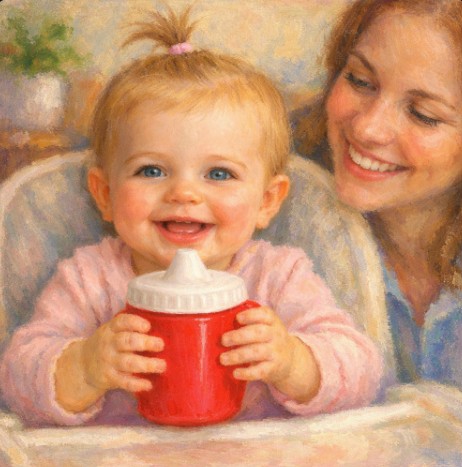
The short answer is that most babies are ready to start practicing with a cup around 6 months of age, when they can sit upright in a highchair and are beginning solid foods. (And by “solid foods,” I really mean runny green beans and mashed potatoes!)
But here’s something many parents don’t realize…
When you introduce a cup isn’t nearly as important as which cup you choose.
As a retired speech-language pathologist with over 40 years of experience, I’ve found that the right cup can encourage more mature drinking skills, make the transition away from bottles easier, and support healthy oral development.
When should you introduce a sippy cup?
Most babies are ready to begin practicing with a cup around 6 months of age, when they have good head control, can sit upright, and are starting solid foods.
At first, think of the cup as something your baby is learning to use, not their primary way of drinking. Continue breastfeeding or bottle feeding while they practice this new skill.
Most children gradually transition away from bottles around their first birthday.
Why does the kind of sippy cup matter?
Many sippy cups are designed to be “non-spill.” While they certainly save your floors and your car seats, they’re not my favorite choice for everyday use.
These cups contain a valve that only opens when your baby creates enough suction. That means they have to suck much harder than they would from an open cup or a regular straw.
This encourages babies to keep using the immature sucking pattern they learned as newborns rather than developing the more mature tongue movements used for drinking from a cup.
Ideally, I’d love every baby to drink from an open cup—but let’s be realistic! That isn’t always practical.
A great compromise is a cup without a spill-proof valve. If you tip it over, a little liquid will spill out—and that’s actually a good thing. Because the liquid flows more easily, your baby doesn’t have to suck as hard and can practice the more mature drinking pattern they’ll eventually use throughout childhood.
Are sippy cups bad for teeth?
Sippy cups themselves are not inherently bad—especially if you choose one without a valve.
The bigger concern is what’s in the cup and how long your child carries it around.
Sipping juice, sweet drinks, or even milk throughout the day (or at bedtime) allows sugars to sit on your child’s teeth for long periods, increasing the risk of cavities.
Sometimes parents say, “They’re only baby teeth.”
But baby teeth matter. Cavities can be painful, affect eating and sleeping, and I’ve worked with children whose mouths were so sore that they didn’t want to eat or even talk.
Are sippy cups bad for speech development?
Not all sippy cups are a problem.
However, cups that require strong sucking may encourage babies to continue using an immature tongue pattern rather than developing the more mature movements used for drinking and swallowing.
If this pattern continues for a long time, it may contribute to tongue-thrust swallowing in some children and can make sounds like s and z more difficult for some children to learn clearly.
That certainly doesn’t mean every child who uses a valved sippy cup will have speech difficulties. It simply means I’d rather encourage the more mature drinking pattern whenever possible.
Are straws or sippy cups better?
If I had to choose between a regular straw and a spill-proof sippy cup with a valve, I’d choose the regular straw almost every time.
Because regular straws don’t require as much suction, babies can usually use a more mature drinking pattern. In fact, when your child is learning to drink from a straw, a small juice box can be used. At first your baby doesn’t know that if they suck on the straw anything will happen, but you can simply put the straw up to their lips and squeeze. They usually get the idea right away.
An open cup is another excellent choice for practice, even though it can be a little messy at first.
How do you transition from a bottle to a cup?
Many children become attached to their bedtime bottle, but by around 12 months of age, it’s a good idea to begin phasing bottles out.
Bottles encourage the same immature sucking pattern used during infancy, and falling asleep with milk on the teeth also increases the risk of cavities.
Parents have shared several strategies that worked well for them:
- Gradually dilute the milk with water. Start with about one-quarter water and slowly increase the amount each week until the bottle contains only water.
- Make the cup more exciting than the bottle. Offering milk in a favorite cup before bedtime often makes the transition easier.
- If your child absolutely refuses to give up the bottle, some parents carefully snip the end of the nipple to make sucking less satisfying. Many children lose interest once they can’t suck effectively.
The one modification that fixes most sippy cups
If someone gave you expensive spill-proof cups, don’t throw them away.
Simply remove the valve.
Yes—it gets messier.
And that’s the point.
A little spilling means your child is actually drinking instead of having to suck hard to get every sip.
Can I use a spill-proof cup sometimes?
Absolutely!
No one wants their baby soaking Aunt Edna’s couch at her 80th birthday party or spilling milk all over Grandpa’s new truck.
Using a spill-proof cup occasionally is perfectly fine.
What matters most is what your child uses most of the time, not every single time.
One thing you can do today
Try not to let your child wander around the house all day carrying a bottle or sippy cup.
Instead, have regular drink times—just like the rest of the family.
Offer plenty of water between meals, milk with meals or snacks, and save juice for special occasions or breakfast rather than all-day sipping.
Cheryl’s Practical Tip
Sometimes you can find the older Tupperware cups at garage sales or thrift stores. They have lids but no spill-proof valve, making them wonderful little practice cups.
They’re becoming harder to find, so if you come across a few, grab them—and when your child outgrows them, pass them along to another family.
Bottom line
Start practicing with a cup around 6 months of age, but don’t stress too much about the exact timing.
The type of cup matters more than the timing.
Whenever possible, choose an open cup or a cup without a spill-proof valve. These cups encourage more mature drinking skills, make the transition away from bottles easier, and support healthy oral development.
Don’t worry about a few spills.
They’re simply part of learning.